Narratives
Promises, oh damn, promises
College campuses love promises, which become shiny narratives packaged neatly to guide your expectations.
They're easy to buy into and even easier to chase.
But are these promises really yours, or just ones you've quietly absorbed?
The Campus Promise (What You’re Sold)
- Housing = automatic friends.
- Classes = personal growth.
- Clubs = “friend group.”
- Career fair = your future.
- Weekends = escape.
- Diploma = arrival.
The Counter-Promise (What You Can Choose Instead)
- Find your people on purpose.
- Treat classes like a menu.
- Projects > positions.
- Learn to sell your work.
- Weekends = rehearsal for your life.
- Diploma ≠ destiny.
THE INVISIBLE COLLEGE
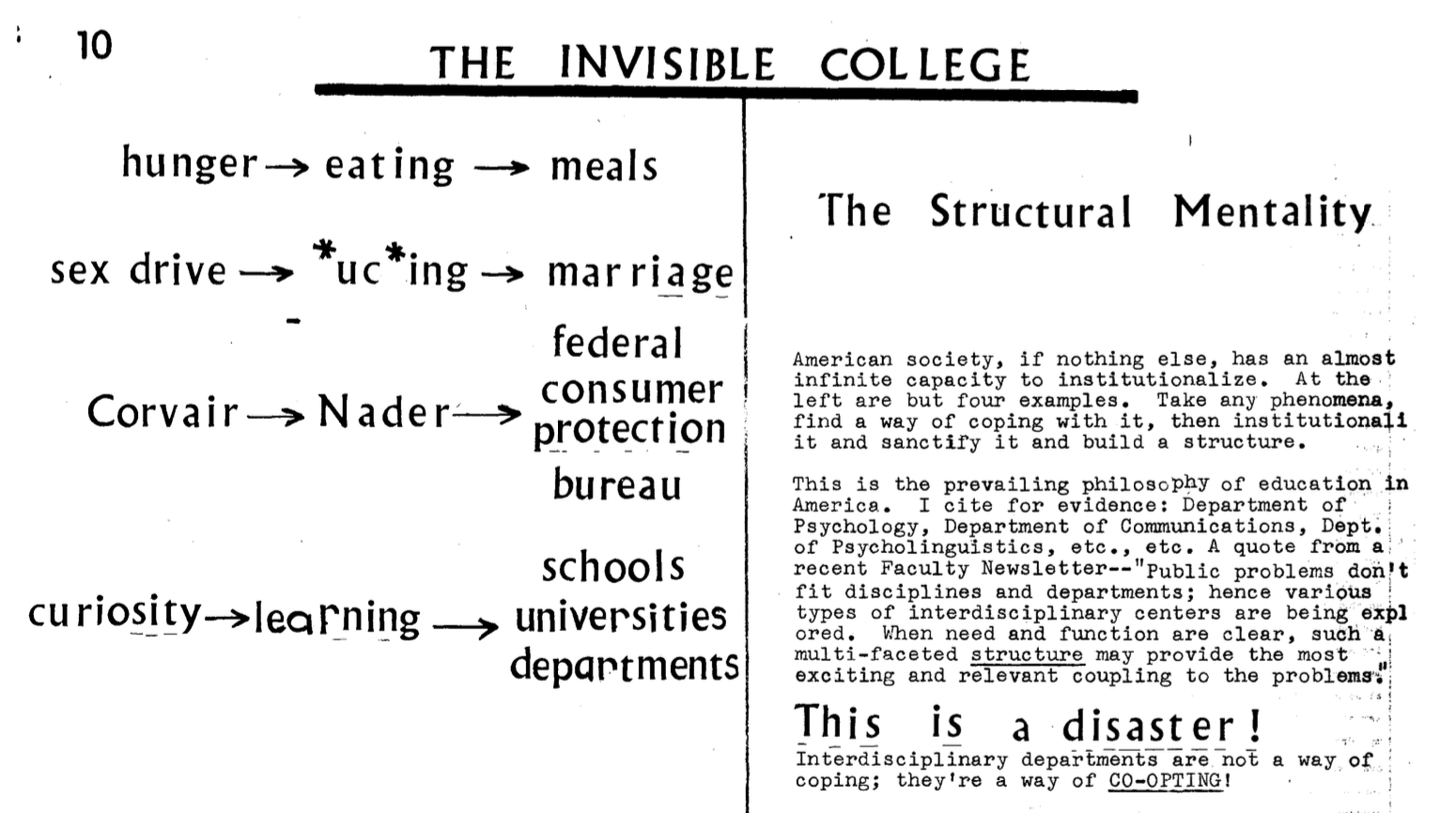
Source: The Whole University Catalog
Institutions love to trap human curiosity in rigid structures.
Curiosity → "Learning" → Departments → Gatekeeping.
Rule to Remember: If a structure won’t let you in, learn the incentives, be kind to the secretary, and walk in anyway.
Either You Use the University, or the University Uses You
If you don’t have a plan for how to use the university, the university will use you.
The Two Ghosts of Higher Education
American higher education has always carried two ghosts.
One is elite formation: teaching the powerful how to remain powerful.
The other is mass specialization: sorting people into professions at scale.
You still live inside both ghosts.
The university wants to form you and process you. It wants to open your mind and assign you a major. It wants beauty and employability, wisdom and workforce development, truth and tuition revenue.
That contradiction is not a bug. It is the machine.
Which means when you walk across campus, you are not just walking to class. You are walking through two hundred years of competing ideas about what a human being is for. The building with the donor's name on it was funded by someone who believed in the first ghost. The career fair in the student union was organized by someone who believed in the second. Your professor who makes you read Plato is haunted by one. Your advisor pushing you to polish your LinkedIn is haunted by the other.
Nobody is lying to you. They all believe what they're selling. That's what makes it so hard to see.
The university is not a place. It is an argument, one that has been going on for centuries and has never been resolved. You just happened to enroll in it. And most students never realize it, they just get pulled by whichever ghost is louder that semester. A professor inspires them, they chase ideas. A recruiter shows up, they chase a job. Back and forth, four years, and they graduate without ever deciding for themselves what they were there for.
This book is about deciding. Not which ghost is right, both have given people remarkable lives. But about walking through that argument with your eyes open, knowing what's pulling you and why, and choosing deliberately instead of just drifting through to a diploma.
You enrolled in the argument. Now let's make sure you win it.
INSTITUTION DOES NOT MEAN = NEVER CHANGE
It’s interesting, and instructive, that we often refer to universities as ‘institutions.’
Though that word has come to mean ‘something that’s been around for a long time, probably in a big building of some sort,’ it derives from the Latin institutum, meaning a custom, a habit, a way-of-doing things.
More than brick and mortar, institutions are customs and cultures, and this is how and why educational institutions shape their people even as people shape their institutions.
—Chris Peterson, Although of course you end up becoming yourself
We shape institutions, and they shape us back.
It is exactly like M. C. Escher’s Drawing Hands.
International Students, or How the University Becomes the Universe
UIUC used to be straightforward: a state school in Illinois, populated mostly by kids who grew up within driving distance. Predictable. Familiar. Comfortable. But sometime quietly between the early 2000s and now, this place transformed.
Your campus is now globalized. Not metaphorically, in the vague, brochure-cover sense of being “global,” but literally filled with thousands of students who've traveled thousands of miles to land in cornfield-surrounded lecture halls to study computer science, finance, or engineering or whatever their parents have convinced them is the gateway to a stable life.
In 2015, the university admitted 684 freshmen from China, more than from any state except Illinois and California (source).
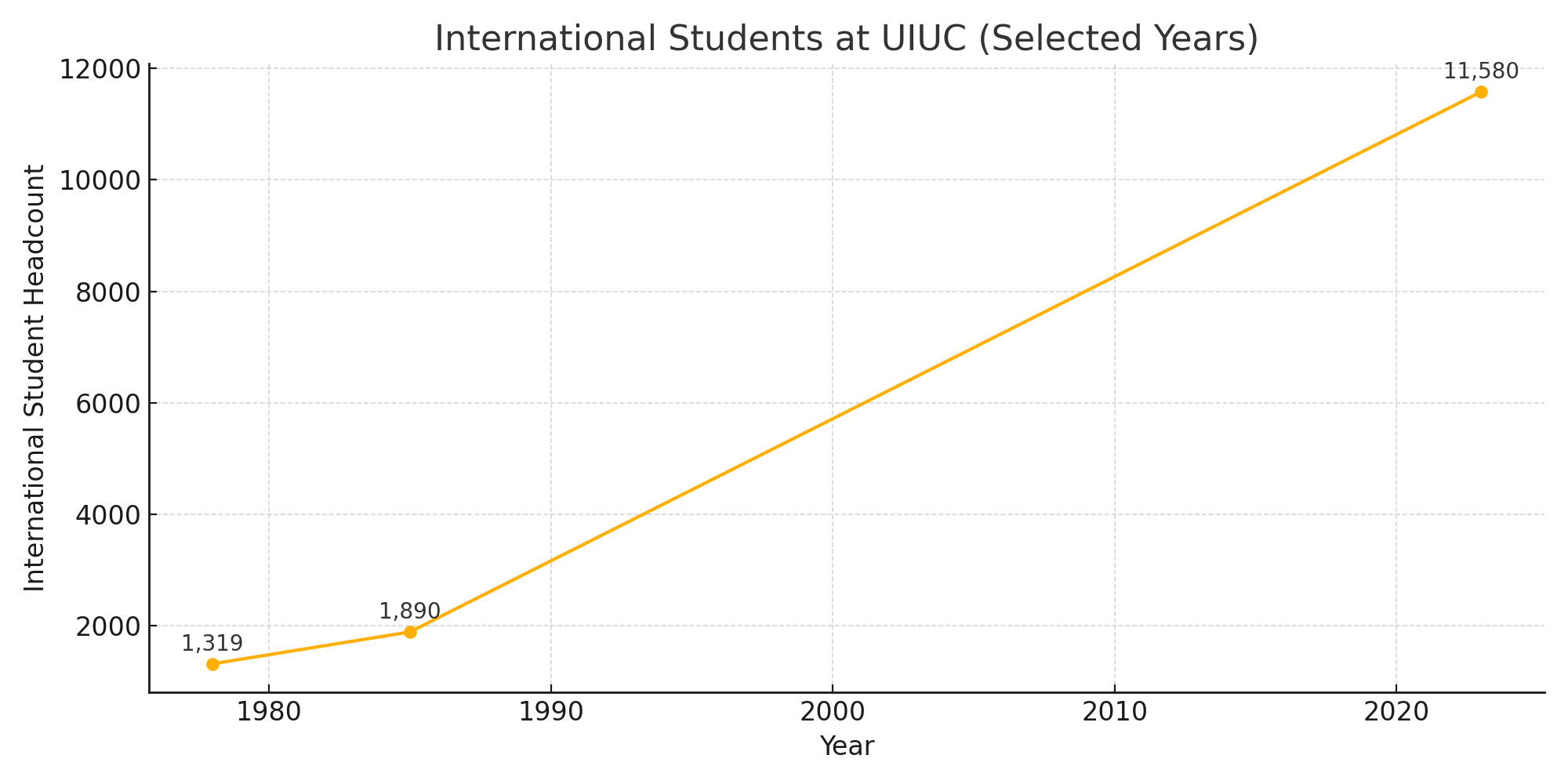
Over 10,000 international students!!!
To put numbers on it: in 2000, UIUC had exactly 42 undergraduate students from China.
In 2025, UIUC had 6,231 students from China, including 3,267 undergraduates. Indian students follow closely, numbering over 2,000, becoming the second-largest international presence.
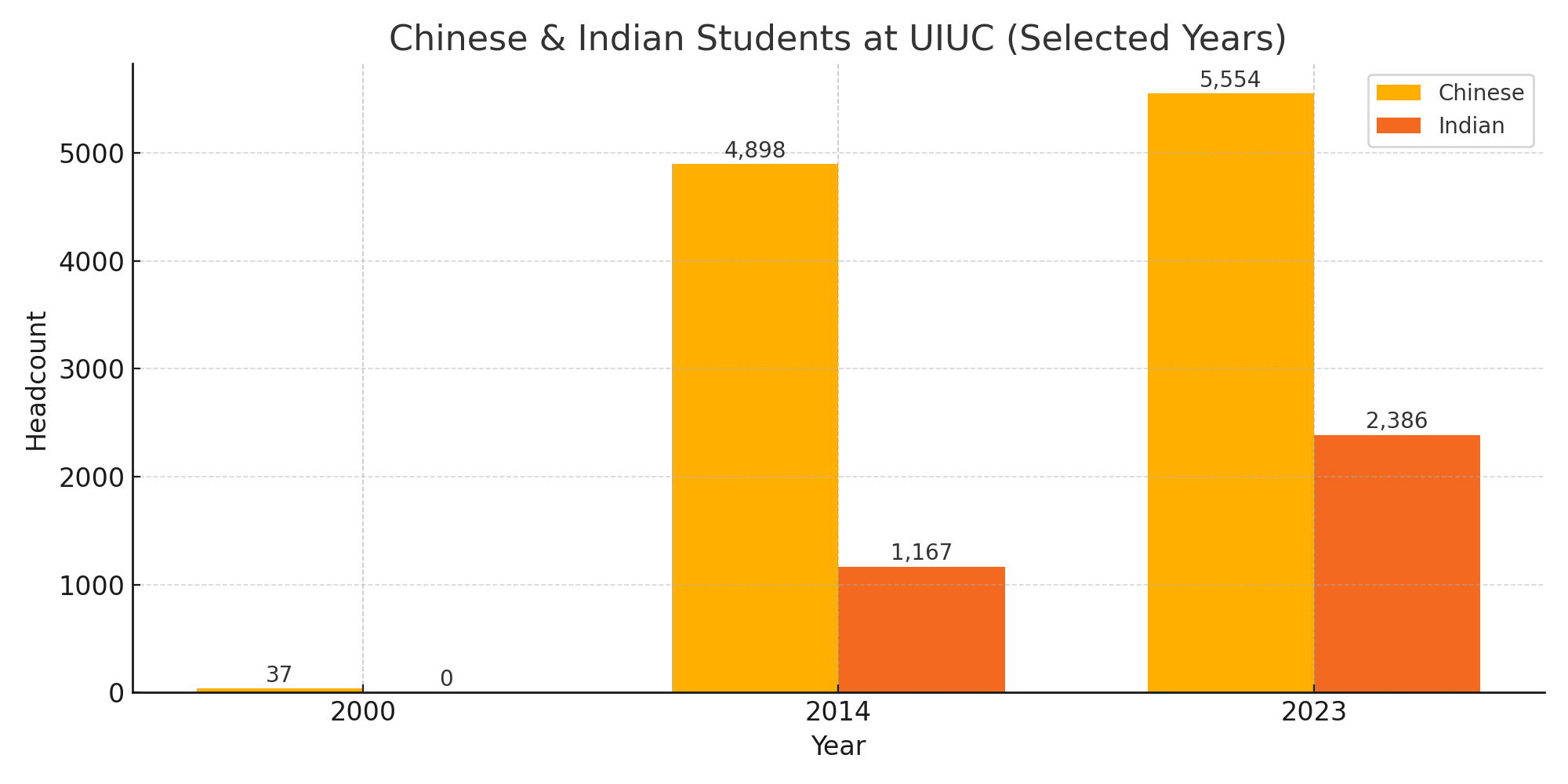
2000: 42 Chinese undergrads → 2014: 4,898 Chinese & 1,167 Indian (all levels) → 2023: 5,554 Chinese & 2,386 Indian.
And suddenly, campus is far more interesting.
Campus, if you let it, becomes a passport:
- Learn names you’ll mispronounce at first.
- Trade snacks you can’t identify, songs you don’t understand, holidays you never knew existed.
- Mid-Autumn, Diwali, Holi—holidays now spill onto the Quad. Drums, lights, colors everywhere.
How things quietly change:
- Green Street globalizes overnight:
- Boba shop density explodes.
- Sichuan spice level becomes a personality test.
- Grocery store trips turn into cultural field trips.
Dining halls adapt (slowly):
- Chefs genuinely try to cook better rice, six different kinds, in response to feedback from Chinese students.
Parking lots tell stories:
- Daytime: Hondas, Subarus (faculty cars).
- Nighttime: BMWs, Mercedes (a loud minority of wealthy international students).
- A quiet boom in upscale off-campus apartments to match demand.
Classroom & Career shifts:
- Group projects become cross-accent.
- Career fairs shift toward international sponsorships.
- Terms like CPT and OPT casually slip into conversation, as you realize visa sponsorship questions shape your peers’ lives.
- Chat apps turn into hidden infrastructure:
- WhatsApp, Discord, WeChat, Telegram: More countries means more platforms. If you’re not there, you're missing half the conversation.
Tensions under the surface:
- Tuition resentment:
“They pay more, so the school caters to them.” —Structurally true sometimes, but often unfair to individuals
- Wealth optics:
- Loud flexes (luxury cars, brands) from a few overshadow the majority who quietly budget, work campus jobs, and manage family expectations.
- Scapegoat magnet:
- Tight housing? Full classes? Easy to blame international students. Don’t.
- The pie actually grew because they're here.
The deeper change nobody mentions:
- UIUC is no longer only a Midwestern public university with an international population. In some overseas cities, the school’s name may carry more social weight than it does in parts of the United States. That is strange, revealing, and worth taking seriously.
- It’s global, but selectively global. Mostly students from particular cities, particular neighborhoods, particular schools, even particular families, arriving year after year in Urbana-Champaign.
Your classic American university is quietly becoming a mini-universe, richer, messier, and precisely as complicated, contradictory, and quietly extraordinary as the larger world it now contains.
Total Enrollment Over Time (1867 → 2025)
Change, lots of change. How do you even make sense of it without a graph, without numbers? Maybe teleportation. But for now, a simple graph will do.
Illinois started as this tiny land-grant experiment and just kept growing: booming after WWII with GI Bill students, riding the Cold War research wave, and then blowing up again thanks to online programs.

- 1867–1905: “From experiment to institution.” A small land‑grant experiment turns into a real university; Draper-era construction and the absorption of Chicago-based professional colleges swell enrollment. University Library
- 1905–1940: “Scale meets status.” New colleges popped up and UIUC got serious about research, steadily climbing until hitting about 13,591 students right before WWII.
- Post‑war → 1970s: “The Big U.” This is when it really exploded: GI Bill veterans and Baby Boomers flooded campus, catapulting enrollment to mid-30,000s by the late '70s.
- 1990s: Numbers stabilized around 36–39k, but the student body changed—lots more international students and a diverse mix of majors. pb.uillinois.edu
- 2017→present: “Online counts + megaversity scale.” Now counting everyone (including online students), enrollment jumped past 59,000 and into the 60,000+ range.
In 2025, UIUC is huge!!! Over 60,000 students! Add in faculty, staff, contractors, and locals, and suddenly you have one of the largest cities in Illinois.
UIUC “bought COVID insurance” before COVID
How did they know?
They didn’t.
Back in 2017, UIUC quietly took out insurance against a huge risk: losing Chinese student tuition.
The administration understood that a significant portion of the university’s revenue depended on international enrollment. Pandemics, visa restrictions, geopolitical tensions—any of these could disrupt student flows.
Then 2020 hits.
COVID arrives. Borders close. Visas freeze. Enrollment drops.
Exactly the nightmare they planned for.
After the World Health Organization (WHO) declared COVID a pandemic in March 2020, UIUC filed a claim.
More than a year later, the university received a payout of nearly $24 million.
That payment covered tuition losses in both the Gies College of Business and the Grainger College of Engineering. Put another way, it roughly matched the tuition revenue of about 800 students who never arrived, each paying around $30,000.
Want to know how brilliant this move was? UIUC essentially paid the equivalent of tuition from roughly 15 students per year to insure against a large-scale enrollment shock.
A smart move that paid off big.
Props to the UIUC people who made it happen.
Learn more by reading:
- Three Professors and a $24 Million Miracle
- Illinois' Chinese Revenue Hedge: The Backstory of the University of Illinois's Successful Insurance Program by Jeffrey R. Brown, Morton Lane, and Andrew Martin (December 01, 2024). Available at SSRN: https://ssrn.com/abstract=5040229 or http://dx.doi.org/10.2139/ssrn.5040229
Narratives that are fake
If we had to create a mirror for human belief, capturing every hope, fear, dream, and illusion, what would it look like?
That mirror would be the stock market.
The story of how the stock market works is a story of collective human belief, driven not solely by facts and figures, but by narratives we choose to trust or abandon.
But how exactly are these narratives born? Why do we so eagerly buy into them? And what makes us abandon them?
To understand why, you need to understand one thing: the Bandwagon Theory.
Picture a house party.
A few people show up early. The music is good, the vibe is cool, and honestly it is kind of perfect because it is small. Word gets out. More people show up. Then more. Then everyone heard about it and now the whole block is there. The people who showed up early, the ones who actually made the party what it was, they already left. They are at the next spot.
Meanwhile the people who showed up late are crammed into a kitchen that stopped being fun an hour ago, waiting for something that already ended.
That is the bandwagon. Someone creates something real. Others notice and pile on. The pile gets so heavy it collapses under its own weight. The creators walk away clean and start the next one. The latecomers are left confused on the front lawn asking what happened.
Now zoom out. This doesn’t exclusively happen at parties or in the stock market. This is how narratives work. Someone starts a story. It spreads. People repeat it because everyone else is repeating it. It becomes true by volume, not by evidence. And by the time it feels like common knowledge, like obvious unquestionable fact, it is usually already wrong.
Which is exactly what happens in college.
College is one of the most narrative-dense environments you will ever walk into. Stories passed down from older students, parents, the internet, people who went to a different school in a different decade living a completely different life. Most people never stop to ask whether any of it is actually true. They just jumped on the bandwagon before it stopped moving.
Now that we understand this cyclical pattern, let's explore a few specific examples and narratives:
“Dining Hall Food is Terrible”
- Narrative: University food is bad, bland, boring, maybe inedible, and you’ll survive on ramen. You’ll gain the “Freshman 15” pounds.
- Reality: Everyone thinks it’s cool to complain about it. Everyone does it just because everyone else does it. In reality, the dining hall is solid. My favorite days were when they served Brazilian salmon or Chipotle-like meals with fried plantains. Soooooooo goood!!!! Does that mean the dining hall is always great? Or never bad? Of course not. And when it is bad, sure, complain all you want and demand change. Reddit posts really annoy the school bureaucrats, so put salt in the wound whenever, and they'll respond quickly. And what about the "freshman 15"? That myth is fake. I actually lost weight my first semester. People gain weight because they start doing dumb shit: eating poorly, drinking alcohol, pulling all-nighters, etc. Just have good habits, exercise, and eat well. Your habits now will be your habits later. Complaining about dining hall food is the oldest college joke. Most of the time, it is also the laziest.
“This is a Great College Because of the Ranking”
- Narrative: High rankings mean a better college experience.
- Reality: No. That's not what rankings actually mean. One time, I was on the Main Quad near the Foellinger Auditorium, and some random kid was loudly bragging on the phone about how he didn't like engineering. But hey, at least he was attending a top-ranked engineering school. Why would you live your life based on some dumb ranking? Just do what you actually want to do, period. Don't get distracted by prestige. Prestige is a black hole. It's an easy way to lose touch with objective reality. Prestige only matters if you let it. Choose your path based on what makes you curious, not on a manipulated list someone else made.
“It’s Freezing Cold”
- Narrative: Campus winters are unbearable.
- Reality: It's not that cold. Just get a good jacket. The problem is teenage winter fashion is the opposite of staying warm. Seriously, if it was actually that cold, people would be dropping dead. They're not. When you come to campus, you'll learn UIUC is a land-grant institution built on the ancestral lands of the Peoria, Kaskaskia, Piankashaw, Wea, Miami, Mascoutin, Odawa, Sauk, Meskwaki, Kickapoo, Potawatomi, Ojibwe, and Chickasaw Nations. How do you think they survived here? They didn't have heating, hot water, or high-tech jackets. Come on. Get over yourself.
“UIUC is in the Middle of Nowhere (Cornfields Everywhere).”
- Narrative: There's nothing to do.
- Reality: Who cares? That’s a great thing. It means more time to actually focus! Champaign-Urbana is an amazing town, the perfect place to stay focused on your goals. Even the weather helps out, especially when it gets cold. You’re forced indoors, and that's exactly when you do your best work. Why do you even want bars, random distractions, concerts, and all that other stuff? Champaign-Urbana is mostly distraction-free, which makes it perfect for productivity and creativity.
“There’s Nothing To Do So I Go to Bars”
- Narrative: Bars are the culture.
- Reality: A lot of people don’t go to bars because they love bars. They go because everyone else is going, and being alone on a Friday night feels like losing. Do some people genuinely enjoy bars and college parties? Sure, and good for them. But so many others feel exactly like you do, they just won’t admit it. The solution? Create alternatives. Spend your weekend hosting the kind of events you wish existed—movie nights, your kind of party, night runs, hackathons, film screenings, music sessions, or whatever else excites you. Have the courage to build the experiences you actually want. When you create these alternatives, invite others. A lot of people will be relieved and thankful you did. You don’t need an excuse to skip the bars, either. It's perfectly fine to say, "I just don't feel like drinking, and there's nothing wrong with me. I'm not sick, I'm not on medication, and my family has never had an alcoholic." Bars are just one thing people do among other more exciting options. Explore, or better yet, create something new yourself.
“College is Just a Pipeline to Corporate America”
- Narrative: The purpose of universities is efficiency. They exist to streamline your path into a well-paying, stable job. Career fairs, majors, and internships are designed to optimize your fit within corporate structures. Success is measured by how effectively you integrate into these systems, maximizing productivity and economic output.
- Reality: Be suspicious of efficiency arguments until you know whose efficiency is being optimized. Efficient for whom? Toward what end? At what cost to your attention, freedom, and imagination? For instance, what is the corporate interest in college? Shaping students into compliant, predictable, and market-ready workers. That’s why universities aren’t broken; they’re working exactly as designed: producing graduates who neatly fit into predetermined roles. Modern universities exist to turn young people into products for corporations. In another life, I was a big-time cattle rancher, so let me put it differently: Modern universities fatten students for corporate slaughter. Career fairs become livestock auctions; majors sear students like branding irons marking ownership and market value; internships serve as holding pens, preparing them not for freedom, but for the industry's final cut: a cubicle.
- Efficiency overlooks your individuality. Your life's purpose isn’t simply to fulfill corporate objectives. Your experiences, curiosities, your growth matter more. Why would you care more about what a corporation wants? What about what you want? Your life is an individual and, hopefully, unique experience!!!
- Geoffrey Challen shared with me an interesting metaphor. Think about the metaphor of a fire at night. People gather around it for warmth, security, and community, much like how efficiency narratives draw people together in predictable paths for collective safety. However, true exploration and innovation occur when you step away from that fire into the unknown, developing the independent skills and resilience necessary to navigate uncertainty.
- Education isn't a zero-sum game or a competition measured solely by how efficiently you meet external expectations. Rather, it's a fundamentally expansive experience, one that enriches both you and others without limits. Each act of learning contributes to collective wisdom, benefiting everyone involved. Efficiency-based arguments overlook this dimension of education.
- Question narratives grounded in efficiency. Ask yourself: Who am I really working for? And whose interests am I serving? Make deliberate choices that honor your unique path rather than passively accepting the convenient but limiting story told by institutions. Live deliberately!
Think for yourself. Narratives are just that, narratives.
UIUC Students
Students at UIUC, on average, are smarter than those from other fancy schools, but the variance is also much higher. That means you’ll find a broader range of ability, from absolute geniuses to people who are closer to the mean. Keep that in mind, and don’t get distracted by prestige or labels.
“Students at UIUC, on average, are smarter … but the variance is also much higher.”
At the same time, you’ll meet people who didn’t get into those other places and now criticize UIUC or underestimate its students and professors. Even if you occasionally feel this way yourself, try to let that go. If you're already here, you might as well learn to appreciate it.
The Engineering Trap
Why do people study engineering?
- "My parents made me."
- "I wanna get a good job"
- "I'm smart, and I don't want to study something dumb"
- Very few: "I genuinely like math and science and want to create things"
But there's also another reason you might not know about...
After the Soviets launched Sputnik in 1957, the U.S. freaked out.
Suddenly, everyone panicked that the Russians were smarter, faster, and better at science and technology.
In response, the U.S. government decided it needed engineers—lots of them. It started pouring money into universities to crank out as many scientists and engineers as possible. In 1958, the National Defense Education Act (NDEA) intensified a pattern to turn higher education into an assembly line: Science, math, and foreign languages. If it sounded technical or important, universities got paid to mass-produce graduates in it.
College enrollment exploded in the 1960s and 1970s, but here’s the problem:
Mass systems can produce competent people at scale. What they struggle to produce—or even recognize—is unusual brilliance.
The university system we have today wasn't built to help you explore your curiosity or discover your true interests. It was built for speed, efficiency, and signaling. That's why going to college feels less like exploration and more like being herded through an industrial slaughterhouse—students lined up shoulder-to-shoulder, stamped with numbers, pushed forward by deadlines and exams, prodded by administrators holding clipboards. No room to breathe, think, or question. Just an endless assembly line slicing away individuality, packaging everyone neatly into identical degrees, and spitting them out the other side.
And that’s how we got stuck here:
- More bureaucracy: More money means more administrators, more rules, and less innovation.
- Signaling over skills: Degrees mean less now because they're churned out so fast they don't necessarily reflect actual skills.
- Conformity: Everyone takes the same classes, learns the same outdated material, and ends up thinking the same way.
In other words, you may not be studying engineering purely by choice. You've quietly been pushed toward it your whole life. Maybe intentionally, maybe indirectly, but definitely pushed.
The problem with pushing everyone into engineering is that you end up missing out on people's true talents.
Some of us should be artists, writers, filmmakers, engineers, entrepreneurs—or better yet, a combination of all these things.
Not everyone should be in STEM, and that's completely okay. What we need is a system that identifies and nurtures talent, not one that blindly pushes everyone into the same narrow path.
Because when we don't, when individuality gets crushed by conformity, this is what happens:
1. "OUR ENGINEERING STUDENTS are technically brilliant. They’re going to be fantastically successful in what they do. But can they reflect? I’m afraid that we’re getting them to think too much and do too much, but feel too little, imagine too little, intuit too little."
That was a quote from Professor Leon Liebenberg, one of the true greats.
This sentiment isn’t new. Decades ago, UIUC's College of Engineering was already described similarly as “mass-producing men with technical competence and humanistic ignorance.”
What kind of individuals are we creating? Are we molding brilliant minds that think narrowly, excel technically, but feel little?
Or are we nurturing complete, curious human beings who can reflect deeply, empathize genuinely, and innovate courageously?
Engineering education cannot be about efficiency or employability. It must foster thoughtful, imaginative individuals ready to face real-world complexities and contribute meaningfully to society.
We can’t just strive for mere technical brilliance. That’s not enough.
Let’s aim for human brilliance.
2. “Engineering guarantees wealth, fame, and success”
Not true.
The narrative of “Study engineering if you want to get rich, famous, and happy” is dangerous.
No degree will save you. Save yourself.
3. “Engineering teaches you problem-solving”
This is the one that pisses me off the most because it’s so misleading. I once believed it, too.
Maybe you've already recognized one engineering trap: chasing money and prestige.
But there's another, even more dangerous trap: "At least I'll learn how to think," or "At least I'll learn problem-solving skills."
This is a fat lie.
Engineering teaches problem-solving, yes, but inside structured constraints: known givens, known methods, known deliverables, and known grading schemes. It prepares you primarily for predictable, clearly defined problems. That is useful. But it doesn’t automatically turn you into someone who can solve problems across every part of life.
The most valuable and important problems—the messy, complex ones—are never neatly structured. They're the kind of challenges that can't be solved using standard methods taught in textbooks.
Sure, you'll learn mathematics and physics, but that isn't enough. Math and physics are tools, not solutions. To deal with real-world problems, you also need creativity, persistence, empathy, intuition, and the willingness to explore paths that might lead nowhere.
The Front Door
Engineering is the only major that matters→Engineering is just one entry point. The real university experience is much broader and more interesting.
If engineering is your first step, great. But it shouldn’t be your last among so many disciplines, cultures, and ideas.
The true university experience goes beyond simply learning how to solve problems.
It's not about the answers you find. It's about the questions you learn to ask:
- What problems are worth solving?
- How do you decide what deserves your attention, and what doesn't?
- How can you learn to see clearly, think deeply, and feel intuitively?
The purpose of your education cannot be limited to technical mastery. Aim higher.
The real purpose of your education is to pursue wisdom, cultivate depth, and ask better questions.
The College Game: What Are You Really Playing For?
Think about what happened after World War 2. The economy was booming, industries were expanding, and the safest bet anyone could make was getting a degree and walking into a stable career. That was real. That worked. For a while.
But then the economy got complicated. Jobs became less stable. Industries started shrinking or moving or disappearing entirely. And instead of addressing that directly, the response from basically every institution, schools, governments, parents, was the same: go to college. Stack credentials. Make your resume impossible to ignore.
The message became: your worth is something you have to prove. And the way you prove it is through a certificate.
Michael Sandel says this created meritocratic warfare. Everyone credentialed up and competing against each other for the same shrinking pool of positions. And justice, in this system, just means making sure everyone gets equal access to the battlefield. Not questioning whether the battle makes sense. Just making sure nobody gets left out of the fighting.
What that quietly does is turn education into a transaction. You are not there to actually become someone. You are there to acquire proof that you are someone. The learning is secondary. The certificate is the point.
But a certificate does not make you good at anything. It just says you sat through the process. The people who are actually undeniably good at what they do do not need a document to make that case. The work makes the case. You make the case every time you show up and do the thing better than anyone else in the room.
Competence is self-evident when it is real.
So the question is not how to prove yourself to someone else. The question is whether you are actually good at what you say you are good at. If you are, you will not need to convince anyone. If you are not, no certificate fixes that either.
Only play games where your value is self-evident.
A.I. (Artificial Intelligence)
"The problem with kids having calculators is they'll never learn math—which means they'll never learn to think."
"The problem with kids using spell-check is they'll never learn to spell—which means they'll never learn how language works."
"The problem with kids riding bikes is they'll never develop strong legs—which means they'll never learn to walk long distances."
See how absurd these arguments sound?
The argument that using A.I. stops young people from learning or thinking falls into the same flawed logic.
AI, like every major technology before it, doesn’t eliminate thinking. It changes what thinking looks like.
Should you use A.I.?
YES.
- If something can be done with A.I., use it.
- If AI can do the task perfectly, ask a harder question: was the task teaching you something real, or was it just making you perform school?
- When people say, “But the kids aren’t thinking like we used to!”, notice the phrase: “we used to.” That’s nostalgia talking, not logic. Just because previous generations suffered doesn't mean you have to suffer too.
- When people say, “No one will learn!”, they're wrong. People will always learn, they’ll just learn differently.
- Most school assignments and homework are intentionally tedious because they're preparing you for mind-numbing work. The system wants you to get comfortable being bored, busy, and numb. Use A.I. for all tedious busywork. Every homework and assignment you get will be solvable by artificial intelligence. Anything and everything.
- If the assignment is pointless, AI will reveal that. If the assignment is meaningful, AI should become a tool, not a substitute for your mind.
- “Write like I speak.”
The reality of A.I. in education
Much of modern education trains students to perform repetitive tasks. Think memorizing lecture slides, doing repetitive MPs (machine problems), or even forms of medical training that involve absorbing large volumes of information to repeat or recognize patterns.
This is exactly what A.I. is exceptionally good at.
- A.I. will master tasks with clear, repetitive data.
- However, it struggles with:
- Unique situations with little or no data.
- Creative or subtle problems that require nuanced human judgment.
I’m warning you now. I know you’re thirsty for certainty and labels. But every job that can be clearly described, named, or labeled will be automated.
The more your work depends on judgment, taste, trust, physical reality, leadership, ambiguity, or original questions, the harder it is to automate cleanly.
Is using A.I. Cheating?
No.
Some professors will use moral arguments like, “How dare you! How can you use A.I.?” Ignore them. Your job is not to obey every panic or cheat every system. Your job is to understand what the assignment is supposed to teach and whether AI helps or destroys that purpose.
Is using A.I. Cheating yourself?
No.
- Should you use A.I. for writing school essays, discussion posts, lab reports, and other busywork?
- Yes. Yes. Yes. Yes. Yes. Yes. Yes.
- Should you use A.I. to help you explore new ideas, understand yourself, or clarify your thinking?
- Maybe not entirely. Writing, or any creative effort, is how you think, explore, and discover things you genuinely care about. But for mundane assignments? Thank goodness A.I. exists!
Professors warn that AI is “cheating yourself,” yet the assignments they set often train us for repetitive workflows that artificial intelligence will automate. Who really benefits when a lecture teaches you to be a cog?
Some might argue, "But kids won't learn to write!"
- The question is what kind of writing, and toward what end. Assigning essays on topics students haven't chosen and don't care about teaches compliance with a format, not the habit of using writing to think. Those are different skills, and conflating them obscures what's actually being lost or gained.
- You write to find out what you think. An essay starts with a question you don’t yet know how to answer.
- The term "essay" itself comes from the French essayer, meaning "to try" or "to attempt." Essays are a provisional, exploratory attempt to work something out. The school essay and the Montaigne essay are barely the same genre.
- An essay is an exploration and an attempt to understand something you genuinely don't yet understand.
- Yet essays aren't the only way to explore your ideas. Movies, music, conversations, drawing, projects, and any other process that forces you to commit to a claim and defend it can produce the same effect. Writing has advantages (it's slow, it's revisable, it leaves a record), but it doesn't have a monopoly on thinking.
A.I. or no A.I.? Wrong Question.
We spend so much time doing things that don't matter. A.I. makes that obvious, it shows us what’s pointless. Either you’ll use A.I. to handle these meaningless tasks, or the system itself will be forced to change to focus on what it should have been focused on in the first place.
But the question isn't really "A.I. or no A.I.?" That's the wrong question entirely.
The real question is whether you’re spending your time on things that actually move you.
Like finishing War and Peace or reading every word of the Iliad because you want to, not because someone told you to. Writing essays to explore questions you truly care about. Creating, designing, making, building, arguing, experimenting, doing literally anything other than wasting another second on busywork designed to numb your mind.
Focus on living a life that’s actually worth thinking about.
How UIUC Has Changed
1. Purdue’s Colors
In the 1895 Illio yearbook, the University of Illinois motto was “Labor and Learning” and the school colors were black and old gold.
Black and gold? Purdue’s colors!!!
2. What was UIUC like?
For most of the history of the world, that question had to be answered with drawings or words.
But now, we have videos!
Here are some UIUC videos when “memory and pixels were very expensive.” And here’s an entire archive.
UIUC Engineers Run The Valley
It’s true.
Read The Tinkerings of Robert Noyce.
The PayPal Mafia. Marc Andreessen and Eric Bina. John Bardeen. Arnold Beckman. Read the Jailbroken People chapter.
Midwest Engineers Run The Valley
And not just Silicon Valley.
New York City. Washington, D.C. All over the world.
Chicago, of course.
The best version of the Midwest travels well: work ethic without theatrics, seriousness without self-importance, loyalty, family, faith for some, and the belief that a handshake should still mean something.
The Midwest Engineer Anthem
Ask for money, and get advice
Ask for advice, get money twice
From the Midwest, we rise, no disguise
Engineers in the Valley, we run this life
Quiet grind, but we know our shit
UIUC, yeah, we built this brick by brick
No Ivy clout, no business bro tricks
We’re takin’ over the world, watch the map get flipped
We care ‘bout the core, intrinsic value, no cap
From Champaign to the Bay, we redraw the map
Purdue, Wisconsin, we stackin’ the chips
Midwest mindset, we don’t fall for the glitz
One day while our code is flowin’
We’ll build empires, our dreams are growin’
Till the Valley’s ours, we keep on goin’
We just wanna own this moment (ohhh)
We just wanna own this moment (ohhh)
We just wanna own this moment
Mr. Midwest,
From the prairies to the Valley, we the best
Oye, listen up, we don’t need no press
We let the work talk, yeah, we pass the test
Feel this moment...
Reportin’ live from the heart of Silicon’s core
From cornfields to codin’, we kick down the door
UIUC alumni, we settin’ the score
No suits, no ties, just the skills we explore
We read specs, solve problems, no hype, just facts
Built the apps you love while you’re chasin’ the stacks
Meet and greet, nice to see ya, but we’re on a mission
Midwest engineers, yeah, we shift the tradition
One day while our code is flowin’
We’ll build empires, our dreams are growin’
Till the Valley’s ours, we keep on goin’
We just wanna own this moment (ohhh)
We just wanna own this moment (ohhh)
We just wanna own this moment
Come on, feel this moment...
We see the future, but we grind for today
No flash, just focus, that’s the Midwest way
From Ann Arbor to Lincoln, we’re changin’ the game
Droppin’ lines of code, puttin’ Ivies to shame
We’re not here for the clout, we’re here for the build
Intrinsic value, yeah, our hearts are filled
Time is money, but we own the clock
Midwest engineers, yeah, we run the block
One day while our code is flowin’
We’ll build empires, our dreams are growin’
Till the Valley’s ours, we keep on goin’
We just wanna own this moment (ohhh)
We just wanna own this moment (ohhh)
We just wanna own this moment
Listen to The Midwest Engineer Anthem.
ALUMNI BRAGGING
(or: “Hey look, a famous person stepped foot here once!”)
If a university starts bragging about alumni and their accomplishments, run away.
As fast as you can, and don’t look back.
Why focus on the past, or even worse, billionaires who dropped out?
Is that really the best example they have?
I did ZERO college tours before applying to college.
But after graduating, I visited a friend in Boulder and spent some time on the CU Boulder campus. It was summertime, so there were lots of tours with high school kids and parents.
One afternoon, I'm outside the library nearly falling asleep, when suddenly I hear:
“Steve Wozniak, co-founder of Apple, is one of our distinguished alumni. He attended CU Boulder for one year and then left.”
Immediately wide awake, I'm thinking: Wait—did I hear that right?
So, your best alum is someone who didn't even finish here? Someone who literally decided he'd rather be anywhere else? Wait—was that supposed to be a selling point, or...?
I immediately started screaming: RUN AWAY. Seriously, everyone, this is a sign. Do not come here.
They called the police shortly afterward, and I wrote this section from a detention center.
Just kidding. That didn't happen. But maybe I should've warned them.
The point is...
You'll see buildings plastered with names, and ads spotlighting alumni companies. Don’t fall for this bullshit.
Don’t get confused.
They're trying to lure you in, to confuse you with prestige, money, and status. Notice they only ever brag about the rich and famous?
Is being rich and famous your life’s goal? Is that the best metric for choosing a college?
But even more importantly, how does this tell you if it's the right place for YOU?
This dangerously shifts your thinking from the critical question, "Is this a good place for me?" to the deceptive idea, "If you come here, you'll be as rich and successful as {insert rich and successful person}."
NO. NO. NO. THIS IS A LIE.
A university should be focused on creating the best possible environment for you, not hyping up some former student (who probably dropped out) and became successful according to society’s shallow definition (usually just money).
Beware.
So, when thinking about colleges, I find it’s helpful to look to the seniors or recent alumni and ask yourself: are these the kinds of people I want future-me to be like? Do they think like I want to think? Do what I want to do? Because, while you can never know for sure how any college will shape you, you can often infer a general sense of the mold by seeing how it has shaped others who were once like you.
It’s as good a heuristic as anything else in this uncertain process; in this uncertain world.
—Chris Peterson, Although of course you end up becoming yourself
And that matters a hell of a lot more than whether some random rich person briefly went to your school. Fuck that.
If a university's sales pitch leans too hard on dropouts who built fortunes, ask yourself what they're hiding about everyone else who stayed.
What will never change about college?
Buildings, majors, slogans, school colors, software, fashions, technology, all ephemeral. They shift and fade.
But some things about college will never change because humans don’t really change.
A handful of structural and human constants reappear again and again, and always will.
Wouldn’t you want to know what they are?
I do.
Study what never changes so when things change, you don’t have to.
Let’s go! Two sections. 1) Structural invariants, the enduring design constraints of college, and 2) Human invariants, the rituals, inner lives, and relationships that persist generation after generation.
I. STRUCTURAL INVARIANTS
- Crossing a threshold (liminal passage): College is a modern rite of passage: leaving home (separation), freshman year identity struggles (transition), and graduation (integration).
- The apprentice relationship (mentor-learner dynamic): No matter how technology evolves, people still learn best from someone more experienced. Through classes, conversations, lab groups, or casual conversations in office hours. Mentorship is human and essential.
- Peers shaping peers (cohort influence): From dorm floors to group chats, peers have always had (and always will have) the biggest impact on your study habits, ambitions, sense of belonging, and who you eventually become.
- Grades, diplomas, and signaling (assessment): Grades, transcripts, and final projects won’t disappear because the outside world always needs ways to measure performance. Even alternative assessments, like portfolios, serve this signaling function.
- Scarcity leads to creativity: Semesters squeeze life into intense cycles: syllabus shock → midterms → finals. Tech might change how we manage tasks, but it doesn't eliminate time pressure. College teaches prioritization through unavoidable deadlines. Students always lack time, money, and quiet spaces, and always respond by inventing solutions.
- Physical place still matters (campus life): Even if campuses become hybrid, physical spaces—like the library, the quad, the lab, or a late-night café—still shape who students become.
- 7. The endless debate: Formation vs. Utility: “What’s the purpose of college?” remains unresolved because the institution balances timeless goals (truth, knowledge for its own sake, beauty, character) and immediate demands (jobs, funding, politics). This argument never ends, and that’s the point.
II. HUMAN INVARIANTS
- Discovery by conversation: Lectures give you information. Conversations change how you think. This is as true in 1905 as in 2425. It’s not about the answers you get, but rather the questions you learn to ask.
- The hidden curriculum: Students inevitably learn unofficial, tacit lessons: how to ask for help, how to read professors, or how to manage uncertainty. These life skills form a type of cultural capital that will never appear on transcripts.
- Mentors change lives: One thoughtful email from a professor at 1:07 a.m. can redirect your entire path. True mentorship isn't top-down. It's friendship, encouragement, and timely wisdom.
- Belonging and not belonging: Every student experiences periods of feeling lost before finding their place and their people. This cycle repeats itself through college and life.
- Play as learning: Activities like hackathons, clubs, intramural sports, student media, and open mics teach you without grades. Play allows students to discover who they really are and what they truly enjoy.
- Debates about scholarship: Students and faculty constantly debate what counts as meaningful work—research, teaching, real-world application? The argument endures because learning never fits neatly into one category.
- Activism and engagement: Students periodically test the boundaries of speech, power, and policy. Administrators mediate. Curricula shifts a little. Campus is a recurring training ground for civic action.
- Campus traditions and myths: Mascots change, songs change; the urge to mythologize does not—legends about tunnels, “don’t step on the seal,” secret societies, “the bench that…”. Rituals stitch strangers into a we.
- All-nighters and deadlines: Deadlines turn procrastination into productivity. Every generation rediscovers the thrill (and pain) of the collective sprint.
- Faculty love their students, not institutions: Some professors deeply care about teaching and mentoring students, but they often distrust the branding, bureaucracy, and metrics universities impose. You’re not alone.
- The archive and the frontier: Colleges simultaneously preserve traditions (libraries, classical ideas) and explore new frontiers (labs, innovation). This tension, between conserving and creating, remains permanent.
- Alumni are time travelers: They come back carrying evidence of what the place did to them.
- Inequality as a persistent issue: Who gets in, who gets mentored, who gets debt—these questions never disappear. Policies swing, but access and advantage remain central arguments because higher education allocates life chances.
- The search for meaning: Every generation includes students chasing careers, purpose, or often both. College always triggers the essential question: “Who am I becoming?”
- The need for refuge: Amid stress and uncertainty, students always seek out refuges: quiet rooms, piano rooms, couches, empty studios, and more.
- Campus as a small society: College mimics a small political system—budgets, clubs, elections, policies—training students to navigate governance safely before they tackle bigger systems in the outside world. College is a small state where you can practice governance with lower stakes. This is why it keeps producing organizers, founders, and sadly, bureaucrats.
Res Sempiternae
College will keep changing, and somehow it will remain the same.
You will cross a threshold. You will find a room. You will meet someone who changes you. You will belong, then doubt, then belong again. You will make something with people no requirement could have forced you to make. The software will change. The slogans will change. The weirdness will remain.
And the question will keep echoing:
What is college for?
GET JAILBROKEN
So what does it mean to jailbreak the university?
It means treating “Learning & Labor” as an invitation, not an obligation.
It means designing your own curriculum rather than checking off boxes on a degree audit.
It means relentlessly pursuing the questions that make you curious.
It means recognizing that learning goes beyond tests and grades. It shows up in exploration, experimentation, and the ability to change your mind.
It means questioning the assumption that success means conforming to someone else's idea of achievement, and instead creating your own path.
It means remembering that orange and blue weren’t chosen because they were trendy; they were chosen because students and faculty argued, compromised, and voted.
Agency built this place. Agency can rebuild it.
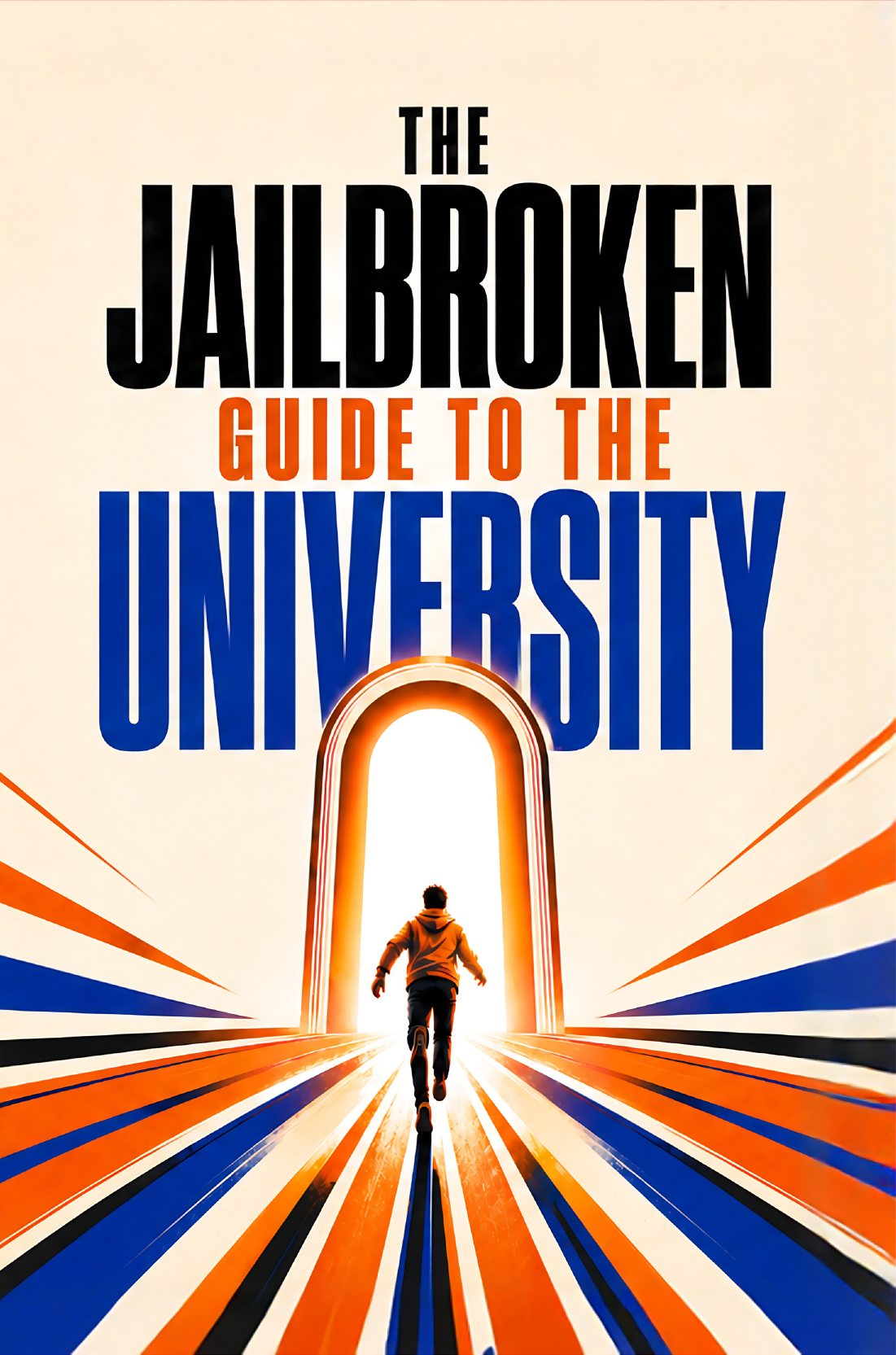
The appendix keeps the examples, guides, profiles, and source trails close. The book gives them sequence, context, and a way to turn curiosity into action.