How to Succeed as an International Student
I’m an interesting case because I’m half international and half a regular domestic student.
I'm not fully an international student, but at the same time, I sort of am. I was born in Venezuela, so I understand exactly what it's like to arrive in a country that's completely foreign, filled with people who seem totally different. I get what happens in your brain when you're suddenly dropped into a new place.
But I'm also not fully domestic, since I moved to the United States at the beginning of high school. That means I understand regular American students, their dreams, worries, and how they think about college, because, well, I grew up with them.
This puts me in an oddly useful position to help you understand how to succeed as an international student. And of course, I’ll be bringing in a few of my actual international friends to share their stories and advice, so you can see exactly what’s possible during your time in college.
What We’ll Cover:
- Thriving in a New Culture: How to make friends beyond your home country, adapt to American culture, stay safe, and navigate practical things like travel and weather.
- Avoiding Visa Pitfalls: The mistakes you do not want to make with your student visa, plus handling internships, OPT, and campus jobs.
- Success Stories: Two case studies of international students who made the most out of college.
- After Graduation: Finding a job, navigating work visas, graduate school, or even starting your own company in the U.S.
Don’t just aim to survive, aim to succeed, and to succeed like very few people before. Let’s go.
1. How to Thrive
1.1 Don’t Hang Out With People From Your Country
Look, you're here to study and learn, sure, blah blah—whatever you think you came to college for.
But a bigger, more important reason is to meet people from around the world. College is cultural education, and that’s arguably the most valuable aspect of higher education.
So go out and meet people from everywhere, from all walks of life. Make new friends and discover the world through conversations.
Being in college is a rare chance to meet people from many countries, maybe even having friends whose homes you can visit across all continents.
Personally, I can stay at friends' houses in at least ten or fifteen places across India, about twenty different states in the U.S., three different homes in China, Saudi Arabia, nearly every country in South America, and around five different countries in Africa.
That is SUPER COOL, and it’s something you can only experience at a university if you actually talk to people. Sit with someone from Nebraska, Nigeria, or New York. Ask about their life. Share yours. You’ll be surprised how receptive people are when you make the first move.
And yes—have friends from your own country. I love people from mine, of course. But don’t make the common mistake many international students make: spending all their time exclusively with people who share their nationality. I know it’s easy. You speak the same language, it reminds you of home and family, I get it. But you can do better.
You’ll regret it later, like many have before you. Expand your worldview.
1.2 Hang Out With People From Your Country
When you arrive somewhere new, you have two options: branch outward into new cultures, or reconnect inward with what feels familiar.
Usually, you’ll naturally lean toward what's familiar.
I'm not going to tell you there's no benefit in spending time with people from your own country. There is.
Let me share something a dear Colombian friend pointed out to me that you might not have realized yet.
Chances are, the people from your country studying abroad are going to return home and do important, influential things. They might become presidents, business leaders, government officials, or entrepreneurs. Being far from home typically means something, whether it's intelligence, family connections, financial resources, or ambition.
In Spanish, there's a word called rosca. It roughly translates to being part of an influential network or social circle.
Many future elites from your country are sitting right here on American college campuses. One day, they'll return home and become significant players in society. And guess what? You already have their phone numbers. Heck, you might've even partied with them already.
I'm not saying you should befriend people based on their status or influence. I never cared about that either. I value other qualities in friendships. But it’s still worth recognizing that these relationships exist. If you don’t want to be close friends, that’s fine. But at the very least, don't make enemies.
If you want to see how real this is, just ask your Indian friends what their parents do for a living. If they’re humble, they’ll say “entrepreneurs.” If they’re feeling bold, they’ll mention the textile empire or the chain of luxury hotels their family runs. And your Chinese classmates? They'll casually drop that mom or dad "works in government," meaning they probably run an entire province.
Whether you're Indian, Venezuelan, Russian, Chinese, Italian—wherever you're from—recognize that the students from your country studying abroad likely have the “rosca” back home: all the connections, influence, and resources that could open doors for you down the road.
“I've often thought there ought to be a manual to hand to little kids, telling them what kind of planet they're on, why they don't fall off it, how much time they've probably got here, how to avoid poison ivy, and so on. I tried to write one once. It was called Welcome to Earth. But I got stuck on explaining why we don't fall off the planet. Gravity is just a word. It doesn't explain anything. If I could get past gravity, I'd tell them how we reproduce, how long we've been here, apparently, and a little bit about evolution. I didn't learn until I was in college about all the other cultures, and I should have learned that in the first grade. A first grader should understand that his or her culture isn't a rational invention; that there are thousands of other cultures and they all work pretty well; that all cultures function on faith rather than truth; that there are lots of alternatives to our own society. Cultural relativity is defensible and attractive. It's also a source of hope. It means we don't have to continue this way if we don't like it.”
—Kurt Vonnegut
1.3 Know Your Worth. Know You’re the “Cash Cow”
I’ll tell you a “secret.”
As an international student, you are a walking goldmine for the university.
You pay full, out-of-state tuition, often without scholarships. You're literally funding the school's existence. Without you—and your tuition—the university wouldn’t look anything like it does now.
Why do I mention this?
Because you have a lot of leverage. Especially if international students come together as a group. Imagine what would happen if you collectively demanded improvements—or even threatened to leave. The university would panic and quickly address your demands.
Your university wants (and desperately needs) your tuition money, so use that to your advantage!
You are a paying customer for a service (education). Good companies care about their best customers. So be assertive about your needs. Don’t let anyone treat you like they’re doing you a favor by letting you study here. You’re earning your place and paying for it, big time.
1.4 How To Understand American Culture?
Welcome to ‘Merica!
You might have visited the U.S. before, but living here is different. It will reveal all kinds of little cultural quirks that might confuse or even irritate you. To thrive you also need to learn the unspoken rules of American social life. Master them, and you’ll find it much easier to connect with people (and avoid misunderstandings).
Here are some American culture oddities that threw me off at first (and some still do!).
I've lived in the U.S. for almost a decade, and some things still baffle me:
- The "How Are You?" as a greeting, not as a question: Everyone says “How are you?” but it’s basically just a “hello” with no expectation of a real answer. Nobody actually cares how you are doing. The expected answer is “Good, how about you?” even if you’re having the worst day of your life. They don’t actually want your life story. The first few times, I actually answered seriously, but they were already halfway down the hall. Lesson learned.
- Ignoring you (but not really): You see someone you know—they clearly see you too—but they just keep walking. It’s not personal. Americans randomly choose to acknowledge you or not, depending on their mood, tiredness, or alignment of the stars. Don’t overthink it. This is one of the weirdest ones for me, and I will never understand it. For me, if I see you and I know you, I will greet you, whether I feel like it or not.
- “Let’s hang out soon!” means never: Americans have a lot of polite phrases that aren’t meant literally. “Let’s hang out sometime,” or “We should grab coffee soon!” often just means “It was nice running into you, goodbye.” It’s a friendly sentiment, but 99% of the time, no actual plans will materialize. Don’t sit by your phone waiting for that invitation, it’s not coming. They’re not being deceptive, it’s just a social nicety. Learn to smile and say, “Yeah, sure, let’s do it!” and move on.
- Texting without greetings: “Did you finish the homework?” or one-word replies like “Yep” are normal. No “hi,” no “how are you?” It's blunt, but it’s just how they text, direct and to the point. I will admit, this is nice, sometimes.
- The “I don’t want to hold you up” strategy: Leaving a conversation or party, Americans love saying, “I’ll let you get back to it,” even if no one is doing anything. It’s code for “I'm bored now, goodbye,” but nicer.
- The Irish Goodbye: Americans sometimes just disappear from parties—no goodbye, nothing. Where I'm from, you say bye at least three times to every human (and dog) in the house. Here? Just leave. Nobody will care.
- “What’s up?” doesn’t mean anything: The correct response is always “Not much,” no matter what’s actually up. It took me years to stop giving actual answers.
- Tipping culture is huge (15-20% is standard): Restaurants, cafés, haircuts, even when someone hands you a takeout bag. Yes, it's ridiculous. Accept it and budget for it. My Indian friends go berserk every time they have to tip.
- Personal space obsession: Americans have an invisible bubble around them. Get too close, and they'll literally back away from you. It's not you—it's them. There’s this invisible boundary that people are very careful not to cross unless you're really close friends. It’s not a universal thing, but it’s definitely American, and you’ll notice it more the longer you’re here. If you come from a place where people are comfortable standing close or touching during conversation, be mindful here.
- “Busy” means you’re not a priority: Everyone here is “so busy.” Usually, that’s bullshit. If someone says they're too busy to meet, it usually means they just don’t want to. Call their bluff and be specific: “Great, see you Tuesday.”
- Using “Sorry” as a Reflex: Americans apologize if they bump into you. Back home, I only say sorry if I’ve seriously messed up—like broken hearts, or angered cosmic forces. Here, “sorry” just means “oops.”
- “Have a good one!”: I still can’t say it. Have a good what? Day? Life? Sandwich? Just reply “You too,” and move on. In the US, saying “Have a good one!” is the casual way to say goodbye.
- The “no offense” offense: If someone says “no offense,” get ready—they’re about to offend you. “With all due respect, but you’re a piece of shit.”
- “I’ll let you know” = they won’t: People often use this phrase when they mean “no.” Don’t wait around forever. Follow up once, then move on.
- Rule-following anxiety: Americans can get tense if you bend (or break) the rules. I like doing it sometimes just to see their reactions.
Adapt
I could go on. Cultural differences are endless, and no list will ever cover them all. The best approach is to observe, stay open-minded, and avoid judging behavior strictly through the lens of your home culture.
What feels rude or strange to you may be normal here—and the reverse is also true.
Just have fun.
And no, you don’t have to adopt every Americanism you see. It’s fine to be yourself. Just be aware of the unwritten rules so you can navigate situations deliberately. Learn the rules well enough to know when they matter and when they don’t.
In other words, understand the social norms so you can choose when to follow them—and when to do your own thing.
1.5 Safety
Is it safe? Yes. Just don’t be reckless.
Use common sense: Don’t wander alone at 3 AM.
A good rule of thumb: nothing good happens after midnight.
Guard your personal information. If something feels off, it probably is.
Trust your gut, unless your gut is unreliable. Then find someone whose gut works.
1.6 How to Get to Campus
You landed, but how do you get to campus?
- Bus
- Amtrak
- Fly to Willard
- Rideshare: Plan ahead. Post in UIUC groups, offer gas money, and include a decent playlist. UIUC moms groups are especially helpful. Have your mom or your “mom” post the request.
If you're worried about money, here's a quick story. I once met a Gujarati guy who proudly claimed he'd never spent a dime getting to or from campus. He always managed to find a ride, one way or another. Sadly, that's not my story, but it's possible.
1.7 Ask Yourself What You Really Want
Seriously, ask yourself: why are you here?
Are you here to learn, get a job, or stay? Are you planning to work a few years, then head back home?
Maybe you just want to party and figure it out later, or perhaps you're considering graduate school, academia, or still have no idea at all.
Not knowing is fine. But having some direction is important. Otherwise, you risk blindly following the crowd: your friend applies to 20 internships, so you do the same, even if deep down you want something else. For example, If your dream is to do research, chasing random internships may not help much. A better move is to find the best researchers in your field and work with them.
One of the most important things you can do is learn from people who came before you. Others have already gone through the same questions, doubts, and tradeoffs you’re facing now. Learn from them. Talk to older students and recent graduates. They asked the same questions you’re asking now.
If you arrived with a major and aren’t confident it’s the right one, think about switching early rather than waiting until you’re locked in. That doesn’t mean rushing the decision—it means being honest with yourself while you still have flexibility.
And, of course, it’s cool if you change your mind. You might come in thinking you want one thing and realize halfway through college that you want something completely different. Totally normal. Revisit these questions regularly and adjust as you learn more.
1.8 The Weather
I don’t care where you come from. I’m from the equator, and trust me, you'll be fine. It’s not that cold. Just bring a damn good jacket, boots, gloves, and a hat.
Done.
People complain about being cold because their jackets suck. Buy a real jacket and stop complaining. Teenage winter fashion is the exact opposite of warmth. Get a proper coat, stay warm, and call it a day.
Winter is amazing. I love it with all my heart. For some of you, it’ll be your first time seeing snow. Enjoy it! Make snowmen, throw snowballs, and be a kid again. Actually, always stay a kid. Life is more fun that way.
1.9 Essentials
American universities love to exaggerate and sell you stuff you don’t actually need: fancy laptops, overpriced textbooks, dorm décor, expensive meal plans, and other nonsense.
Listen, the only college essentials you genuinely need are a decent laptop andsomething reliable to carry your stuff. That’s literally it. Everything else is optional.
Textbooks? Check the library, course reserves, older editions, used copies, open resources, and whether the professor actually uses the book before you hand a publisher $280 for a glossy brick of sadness.
Electronics? A good laptop works perfectly fine, no need for the newest gadgets. School supplies? Buy as you go. You barely need anything extra.
Trust me, once classes actually start, you'll realize how little you need daily: a computer for assignments, a bag to carry it, your ID, and maybe food a couple times a day. Pack light, buy as needed, and don’t get capped by the university's marketing.
2. Visa Landmine Map (Not Legal Advice)
Important note: This appendix is general educational information based on personal experience and research. It is not legal advice. Immigration rules, agency practices, and visa options change, and the consequences of mistakes can be serious. Before making decisions about status, work authorization, travel, or long-term immigration strategy, verify the current rules with your school’s international office, official government sources, and, when needed, a qualified immigration attorney.
F-1 status gives you a way to study in the U.S., but it also comes with rules that are easy to underestimate.
If you mess up, even accidentally, you could get your visa terminated and be forced to leave the country on short notice.
The most important requirement for students on an F-1 visa: maintain full-time enrollment. At the undergraduate level, this usually means at least 12 credit hours each fall and spring semester.
There are limited exceptions. Your first semester and your final semester can sometimes be below 12 credits, but only with prior approval from your school’s international student office.
If you ever drop below 12 credits without proper authorization, your SEVIS record (the government system tracking your status) can be terminated.
Here are a few areas international students usually need to pay especially close attention to:
- Full-time enrollment: Undergraduates usually need at least 12 credits per semester.
- SEVIS registration timing (30-day rule): Your DSO (Designated School Official) must register your status within 30 days of semester start. If you're not fully enrolled or properly registered by then, your record can auto-terminate.
- CPT (Curricular Practical Training): Allows off-campus work related to your curriculum while still studying. Be careful: using 12 months or more of full-time CPT makes you ineligible for OPT. Plan your CPT duration and hours carefully.
- OPT (Optional Practical Training): Provides up to 12 months of work authorization after graduation. Employment must be related to your major and generally at least 20 hours per week to count as valid employment. You are allowed a total of 90 days of unemployment during this period.
- STEM OPT Extension (24 months): If you’re in a STEM field, you may qualify for an additional 24 months. Your employer must use E-Verify, and you must have an approved training plan (Form I-983). Across OPT and STEM OPT combined, you can accumulate no more than 150 days of unemployment.
- Self-employment on initial OPT: You can start your own business during standard OPT, but the work must be directly related to your major and properly documented
- Travel Signatures: Your I-20 travel signature is valid for 12 months while you’re enrolled and 6 months during OPT or STEM OPT. Before traveling internationally, confirm your signature is valid and check with your DSO if anything has changed.
2.1 If your F-1 Visa was terminated, please read this
Near the end of senior year, a student I know got the kind of email that makes your stomach leave your body: his F-1/SEVIS status had been terminated, and he had only days to respond before his life got very complicated.
A course-registration issue made it look as if he was under-enrolled. He eventually resolved it because he had documentation showing he had been trying to maintain a full course load and that the registration delay was outside his control.
The lesson is not “panic.” The lesson is documentation.
If something like this happens:
- Contact ISSS/your DSO immediately.
- Do not rely only on verbal explanations.
- Save emails, registration screenshots, override requests, course approvals, timestamps, and any evidence that shows what happened.
- Ask what options exist: correction, data fix, reinstatement, travel/reentry, or attorney review.
- If the consequences are serious, talk to a qualified immigration attorney.
3. Examples of What’s Possible
Let’s get inspired by some of my friends. I want you to see what’s actually possible.
Arya Haria – How to Maximize Your Time as an International Student (and eating a raw potato for luck)
Arya is a close friend and a perfect example of someone who figured out the rules of the system and maximized them to the fullest. Originally from Mumbai, India, he completed multiple internships and co-ops, earned over $50K, studied abroad in Germany, excelled as a mechanical engineering student, and graduated early after receiving a job offer he couldn’t refuse.
If there was something to do, Arya did it, and did it well.
Now, let’s talk to Arya.
Juan David (JD): You’ve managed to maximize your internships and co-op opportunities as an international student. Can you explain how you approached this strategy?
Arya Haria (AH): It really started with the realization that, as an international student, I had a limited time window to legally work—1 year of CPT (Curricular Practical Training) during my studies and 3 years of OPT (Optional Practical Training, since I’m in a STEM field) after graduation.
So, I knew early on that I had to make the most out of every opportunity that came my way. I began with a Kohler co-op that lasted 7-8 months, which helped me gain valuable work experience and also assisted with tuition costs. My plan was always to study abroad after that because it was financially smart. In Germany, tuition was cheaper, and I didn’t have to worry about paying rent here in the U.S. during that time.
When I decided to go to Germany, the semesters didn’t align perfectly, so I had a gap from December to April. Initially, I thought I would extend my co-op with Kohler, but while I was planning that, I applied for other positions as well. That’s when the opportunity at Tesla came up, and the timing just worked out perfectly.
JD: But how did you realize you could maximize co-op opportunities, internships, and similar experiences? Who told you?
AH: Nobody told me; I figured it out on my own. I don’t think anyone I know has done this before. It just made sense for my situation.
JD: What helped you recognize the value of maximizing these opportunities, especially when most people don’t seem to see it? Elaborate for me, beta.
AH: I spent a lot of time doing research. I made sure I fully understood the rules around CPT and OPT by talking to advisors from different departments—the School of Engineering, the Mechanical Engineering department, and the Office of International Programs—on what I could and couldn’t do. I kept reading the terms and conditions on the university’s international student pages to ensure I didn’t violate any laws or risk getting deported.
JD: What advice would you give to international students on finding opportunities and maximizing their time in college?
AH: Be flexible and consistent with your first job. You probably have no idea what you want or what the company offers, so take what you can get.
Also, keep updating your resume and create a portfolio website. Show as many projects as you can. If you've done similar things before the job, you're much more likely to be hired. Make sure to highlight what you specifically did in each project, not just what the whole team accomplished.
For your resume, use action words and highlight numbers to show impact. Try co-ops because they're easier to get, in my opinion, and they offer a better experience too.
This whole thing is highly luck-dependent, so don’t beat yourself up—just be consistent. Don’t forget to enjoy!
Lastly, eat a raw potato every morning for good luck.
JD: You forgot about the most important factor.
AH: Hmm. Let me think. What did I miss?
JD: Meeting me.
AH: (laughter) Of course, that was the biggest factor!
And just like that, Arya graduated and is already onto bigger things. He's currently at Tesla, working in manufacturing automation in Minneapolis.
It’s wild to think I met him on the first day of Calculus 3 discussion, where we became friends almost instantly, and now he's a big-shot engineer.
If there's one last thing Arya wants you to take away, it's this: everything is negotiable. Don't accept a policy as final just because you read it online. Go talk to a person. Offices can make exceptions, bend rules, and point you toward options that were never written down. Always ask.
Arya told me personally he's happy to hear from readers of this book, so take him up on it. This is LinkedIn.
That brings us to Aaryaman Patel, another close friend, whose path looked very different.
If Arya’s story is about mastering the rules and squeezing every drop out of the system, Aaryaman’s story is about recognizing when the standard path wasn’t working and choosing to listen to the voice within.
Aaryaman Patel — How to Learn to Follow Your Intuition
If you come to college from abroad, you will come with an idea of what you want to do with your life. You may already know what you are supposed to study, the job you are aiming for, and the kind of life that path is meant to lead to. Along with that plan comes a baseline expectation shaped by you, your parents, your teachers, and the beliefs you have absorbed over the years.
Then you arrive on campus. Within weeks, you start noticing what everyone else wants. Some classmates are chasing a specific career path. Others are fixated on the latest trends. You begin to hear the same phrases over and over: “What internship did you get?” “What’s your GPA?” “Is it worth it?” Slowly, a picture forms of what a “successful” life is supposed to look like.
This is all good until one day you wake up and realize you did not make a single choice of your own. You simply followed others.
This is true for everyone, but if you’re an international student, you have more pressure. You left your country. Your family is paying significant tuition. You carry the weight of sacrifice. It feels irresponsible not to try your hardest.
But what if you are trying your hardest at something you never truly cared about?
You have to learn how to listen to yourself. You have to learn how to follow your intuition, and Aaryaman’s story is about many things, but at its core is about learning how to think for yourself.
India is not a single story, and Aaryaman’s experience is not everyone’s. But in the academically competitive circles he knew, certain patterns repeated. From a young age, students are sorted by performance. Exams determine rank and rank determines options. Coaching centers advertise top scorers on billboards. Families compare results at weddings and on WhatsApp groups. A child’s grades are rarely just their own, they belong to the household.
In many middle and upper-middle-class families, the acceptable paths are narrow and well defined: engineering, medicine, finance, government service. These are seen as stable, respectable, upwardly mobile careers. The logic is practical. India has over a billion people competing for limited high-paying opportunities. Credentials become currency. Security becomes the priority.
Preparation for exams like the IIT-JEE can consume years. Students attend school during the day, coaching classes in the evening, and complete practice tests late into the night. Weekends disappear into mock exams. Personal interests are postponed “until after the exam.” Sacrifice now, stability later.
There is also the social layer. In India, extended family has a voice in personal decisions. Uncles, aunts, neighbors—everyone has advice about what you should study, where you should apply, and which careers are “worth it.” Opinions are not always malicious; they are usually rooted in concern. But the cumulative effect is clear: there is a script.
Aaryaman grew up in that atmosphere. Academic excellence was expected. The structure was normal. Planning ahead was assumed. The path meant top grades, competitive exams, and elite colleges.
At the same time, his experience was not identical to everyone else’s. He didn’t feel crushed by the pressure in the way some students do. Part of that was because he had a specific goal early on, he wanted to study in the United States. That ambition gave him direction and a sense of agency. Still, the broader culture of discipline, comparison, and clearly defined success shaped him. Even if he didn’t resist it, he absorbed it.
By the time he left for college, he carried both things with him: the work ethic forged in a high-pressure system, and the quiet assumption that there was a “right” way to build a life.
When he arrived in the U.S., that assumption began to loosen.
For the first time, no one was structuring his day. No one was monitoring whether he studied enough. No one was measuring him against a visible ranking system. The absence of constant oversight created space, but also uncertainty. Without a script, he had to decide what mattered.
That is where the real shift began.
So now we’re going to talk to him, not as “the international student who did everything right,” but as someone who figured out what he wanted and slowly learned to trust his own judgment.
Juan David (JD): So what was your dream when you came to the US?
Aaryaman Patel (AP): It’s what I told you the first time we talked at the ISR dining hall. My goal has always been to use my knowledge and education to help solve climate change. That was my guiding principle.
JD: You came to college from Ahmedabad, Gujarat. You’ve changed a lot since then — at least I think you have. Maybe you disagree. How did you change after coming to the U.S.? What’s different?
AP: The biggest change was developing the ability to think for myself.
That’s almost unheard of—at least for me—as someone who grew up in India. It’s harder to do. It was easier when I was younger, but at some point I think I lost that ability. Coming here helped me regain it — being able to form my own opinions instead of just accepting what everyone around me believes.
JD: Okay, so when you say “think for yourself,” what does that mean? You can definitely think. You definitely thought. You definitely had a brain. I remember during freshman year people would whisper, “Oh my God, I don’t know who that Aaryaman kid is, but did you hear he got 103% on the Calculus III exam? How does he do it? I don’t think he studied.” So you can definitely think. What do you mean by thinking for yourself?
AP: It’s about being very conscious of my time and the opportunity I had by being here in the United States.
That realization was one of the reasons we started the Talkshow. I remember thinking: we’re going to spend four years at this college, and most of that time will go to homework and exams. We might never even meet one percent of the people who exist on this campus.
You have this chance. So why not make the most of it?
That one guiding principle—doing more because you can—was probably the biggest change. And then just prioritizing my own ideas. The things I wanted to work on. I had learned to put those in the back seat growing up—with school, with structured extracurriculars, with everything.
It was almost liberating to realize: I have this time, and I can choose what I want to do with it.
And that not every second needs to be spent doing homework or thinking about classes. There’s a lot more to the world than that.
JD: Say more. Specifically, you said there were things you wanted to do but you always put them off. And then you realized you could be productive in school and also pursue what you actually feel called to do. How did you get there?
AP: You have these four years. You can either just keep your head down, do homework, and graduate. Or you can try something new. Take a chance on yourself.
When I first came here, academics were still my first priority. Everything else came later. But after a point, I asked myself: would I be okay with a slightly lower grade on a test if it meant doing something for myself?
Would I rather get the perfect score that I’m not even going to remember a semester later? Or act on that instinct to create something?
That one thought made the choice a lot simpler.
It made it obvious: this grade is temporary. Something I create could last longer.
It wasn’t that I stopped caring about grades. It was more like I started questioning whether perfection there had to come at the expense of everything else.
JD: I understand that, but it still doesn’t show how you go from feeling “restricted” to saying, “I care more about the thing I’m creating than the grade because that might last longer.” How do you get there?
AP: It was gradual.
I remember the spring semester of sophomore year when we started the Talkshow. That semester changed everything.
We were committed two days a week, trying to release an episode every week. At the same time, I was taking the most credits I’d ever taken, all intensive classes. It wasn’t either-or. It was: I want to do this, and I also want to do this.
So the only option was to figure it out. I still had 24 hours. If I want to do well in school and give the Talkshow what it needs, something has to change. That’s when I realized I might have to compromise, not fail, but maybe give up the perfect score on an assignment for something I actually care about.
So I tested it.
“Okay, I’m not going to study for this quiz all week. I’ll study in smaller chunks. Maybe a day or two before.”
Because I had other things I wanted to do.
And I told myself: if I don’t do well, I’ll adjust. But if I still do well, then that means I can keep going.
It happened once. That affirmed the belief. Then it became: how far can I push this? How much time can I reclaim for personal projects while still maintaining both sides?
It was always about maintaining both.
JD: But you’re saying that now with the benefit of hindsight. You graduated. You know the outcome. You say things like, “If I did bad, I would’ve adjusted.” But that’s not fully true. You weren’t going to let yourself get a B. Or a C. You never did. So why tell the story like that? You wanted to get perfect grades, and you always did. What you’re talking about isn’t accurate.
AP: What’s not accurate?
JD: That getting a bad grade was something you seriously considered.
AP: How do you know?
JD: Did you ever get a bad grade?
AP: I did not.
(Five seconds later)
AP: Well, I did actually in one class.
JD: Was that a hard class, or did you just cap?
AP (admitting guilt): I didn’t have a good professor. If every class was taught by Leon Liebenberg, we wouldn’t be having this conversation.
JD (sighs): True.
JD: Why did the UIUC Talkshow affect you the way it did?
Because it didn’t distract you. It didn’t derail you. It made you more alive. More focused. More ambitious.
And I want to understand that.
If someone else starts a project like that, maybe their grades drop. Maybe they get overwhelmed. Maybe it pulls them apart. But for you, it multiplied you.
So what was it about the Talkshow that woke something up? And answer this as the freshman who just arrived from India—mechanical engineering, structured, disciplined. Not the version of you who already changed. Talk to that person.
AP: The Talkshow was like watching a movie like Interstellar that stays with you after it ends. You walk out and something changed. You can’t fully explain it, but you changed as a person. That’s what it felt like. For me, it felt like the world kept expanding. I think I was drawn to that feeling, just learning from people. That was probably the part I enjoyed the most. Hearing people’s stories. Understanding how they think. Trying to see the world through their eyes.
And in hindsight, it connects. When I look back, I can piece it together. Like, no wonder I want to make movies now. I’ve always been drawn to storytelling in some form. The Talkshow was storytelling. Just in conversation form.
You sit there, you listen, you ask questions, and you realize how big the world is. I don’t fully know why it hit me the way it did. I can’t reduce it to one reason. It just… felt expansive. It was fun.
JD: If you can think of just one thing—one expectation—who did you think you would become after U.S. university? What was that picture in your head?
AP: I don’t think there was a very clear expectation of who I’d be at the end of college.
JD: But you mentioned you had a very structured life growing up. Is that accurate?
AP: Yes.
JD: Okay. So how did that structure impact your development? And then in college, when all of that structure went away, how did you figure out what choices to make?
Because a lot of people come from similar backgrounds—different countries, similar structure—and then suddenly they’re on their own. What do you wish you knew? How did that structured life affect you later on?
AP: I don’t think there’s a right or wrong way.
JD: Sure. But for you specifically — how did it affect you?
AP: I think COVID reset a lot for me.
I graduated high school, and then COVID hit. Suddenly you’re home. You have all this time. There’s nowhere to go. Nothing to optimize for. And I think that’s when I started doing more things for myself. I remember watching Hamilton during lockdown. That had a deep impact on me. There’s a song called “My Shot.” It’s basically about not throwing away your shot. You have this energy, this intellect, these ambitions—so go after them. Don’t waste it.
That idea stuck with me. We have one life. One shot. Don’t waste it. I think I came to the U.S. with that feeling inside me. And then it just evolved over time. But COVID was the point where I really started doing things for myself. There was nothing else to do. So I started making movies at home. Doing random science experiments. Reading a lot. Just… creating.
It was a period of intense creativity. And that continued when I came here. It took some time to adjust to the new environment. But once I got my footing, it was like—okay. Let’s go.
That was also when I started practicing piano more seriously. It just felt like: we have this time. Let’s learn. Let’s build things. Let’s try things.
Just… keep doing things.
But yeah.
JD: What was the hardest non-academic thing to adapt to? Academically, you adapted just fine — blew everything out of the water. But outside of class, what was hardest?
AP: I don’t know if I’d call it “hard,” but initially it was the way people talked. The sense of humor. It was just… different. I didn’t understand how people thought sometimes. What they found funny. What they got offended by. It felt like a different operating system. I remember people laughing at things, and I’d just sit there thinking, “Why is that funny?” Someone would make a joke, everyone would laugh, and I wouldn’t get it at all. It wasn’t painful or anything. Just confusing at first. I had to observe. Try to understand how people think here. What’s normal. What’s casual. What’s serious. It took time.
JD: Is there a specific moment you remember? Like a time you misunderstood something?
AP: Yeah.
I was walking down the hallway in our dorm one day. Someone I didn’t know walked by and said, “Hey, how’s it going?”
So I stopped to answer.
And they just kept walking.
That interaction genuinely confused me. I was like, “Why did you ask me a question if you didn’t want the answer?”
Later I realized people just say that. It’s not a real question. It’s just a greeting. That was super odd to me. If you don’t care about the answer, why ask? It’s not that deep, I guess. But it stood out. Another one. When people leave, they say, “Have a good one.”
I didn’t know what that meant. A good what? A good one of what?
It’s just phrases people use. And you learn them. But at first, it felt strange.
JD: Yeah, I could never say that in my life. “Have a good one.” I can’t do it.
AP: Yeah, I don’t know, man. I still can’t say “have a good one,” because I still don’t know what it means.
JD: What’s the biggest mistake you see international students make that holds them back?
AP: Not breaking out of their shell, and exclusively hanging out with people from their own country during their time here. And it’s not a bad thing. It’s very natural. It’s easy to connect with people who share your language, your background, your references. You’re both kind of the “outsider,” so that bond forms quickly.
It’s comfortable. But if that’s all you do, it’s a huge disservice to yourself.
If you never spend time with people who grew up here, or people from other countries, or just different backgrounds, you’re limiting the whole point of being here.
I’ve seen it a lot. It doesn’t mean those students are unhappy. It just means they stay in a smaller world than they could.
You’re here. Why not interact with people you would probably never meet otherwise? Share a meal with them. Travel with them. Spend time with their friends and family. Immerse yourself in a whole new world.
That’s the beauty of coming here. People from around the world surround you. And you realize that even if you grew up thousands of miles apart, you still share things in common.
That’s a cool realization.
JD: College is like a long-term airport. You’re there for a specific time, and then you’re never in that same place again.
JD: Is there advice you’d give to freshmen — international and domestic?
AP: Don’t take yourself too seriously.
JD: Really? Anyone could say that. A lot of people say that.
AP: Okay, let me elaborate.
When I say “don’t take yourself too seriously,” I mean, if you want to go to the Union and sing karaoke, go. Even if there are five people. Even if it’s ten. If you want to sing your heart out, just do it. If you want to dance, go dance. If you want to build something, find the people. Post on Reddit. I guarantee there’s at least one other person who wants to do the same thing. A lot of freshmen feel isolated. Lonely. And the instinct is to wait—to wait until you feel ready, or until someone invites you in.
But you have to put yourself out there. When you send signals—when you show what you’re interested in—something usually comes back. That’s just how it works. The Coldplay meetup is a good example. I wish I had started it sooner. We started it during our final semester, but it grew really fast. And all it took was one Reddit post and making a GroupMe. That’s it. Domino effect.
So don’t wait. If you want to do something, just start.
JD: That’s not exactly “don’t take yourself too seriously.” It’s more like: take yourself seriously—and be okay if you’re different.
AP: Exactly.
Take your thoughts seriously. Take what you’re feeling seriously.
But don’t put yourself on a pedestal. Don’t say, “I’m too good for that,” or “I can’t embarrass myself,” or “What if people make fun of me?”
In that sense, don’t take yourself so seriously.
JD: Taking yourself seriously. Learning to think for yourself. Connecting to that intuition instead of ignoring it.
Was there a specific decision you made in college that the “old you” wouldn’t have made?
AP: Yeah.
Not trying to find a job right after graduation.
The old me wouldn’t have even questioned that. With visa factors and all the external pressure, I would’ve just followed the standard path automatically.
But I decided to take a chance on myself — to try starting a company. It’s an option, even if it’s less common and less understood. It’s unconventional.
And at the end of third year, I didn’t do an internship. I stayed on campus and worked on my own projects instead.
That’s not what you’re “supposed” to do.
It was taking a chance on myself at the expense of something that’s expected.
JD: Internships and jobs—people worry a lot about those things. You somehow didn’t let it consume you. A lot of people come here with pressure—visa, expectations, family. I wanted to show through your story that even with those pressures, there are other paths. That if someone doesn’t want to follow the standard route, they don’t have to.
AP: And it all comes with a big asterisk. Yes, you can choose not to do those things. But you have to be prepared for what comes with that decision. It can take more energy. More effort. You have to be mentally ready.
If you’re up for it, do it. But you have to be prepared for the consequences of your actions.
JD: Was that pressure real for you? Did it cost you energy?
AP: Yes.
As much as we’d like our lives to be fully our own, they’re not. They depend on other people—their expectations, their support.
It depends on your background. Your family. The kind of support system you have.
I was fortunate. I didn’t have extreme pressure from my parents not to do it. They tried to understand, even though it was unconventional and hard.
But you have to be prepared for how the people you depend on will react.
JD: Sometimes you just can’t help yourself and you have to do the thing you want to do. But you also have to be careful. Your decisions affect other people, especially if people depend on you. And when you take an unconventional path, you can’t compare yourself to other people. You might be misunderstood. You might be judged. That takes energy. People assume the standard path has no drawbacks. It does. They’re just quieter. When you take the unexpected path, the drawbacks are sharper. Closer. You feel them more directly. And you have to learn how to handle that.
JD: Anyways, that was my vision. You were someone, and now you became this person. What changed? Why? How? And I wanted to explore that metamorphosis.
AP: I also think that being put in an environment where you’re forced to become responsible. Independent.
Up until that point, you’re sheltered. Someone’s cooking for you. Someone’s helping you. Your life is structured for you. There’s always support around you making things easier.
Then suddenly, there’s no leash. You’re on your own.
You’re responsible for your safety, your time, your energy, your food—everything.
And when that happens, you’re forced to understand yourself. You form your own opinions. You meet people on your own. You make decisions without asking someone first.
That environment shapes you.
JD: Independent.
AP: Yeah. Being in an environment where you’re independent changes you.
JD: Any other advice or parting words?
AP: One last thing I’d say: talk to your professors.
It sounds obvious, but almost no one does it.
After class, before class, during office hours—ask a question. Explore an idea with them.
It’s underrated.
You have access to some incredible professors. Not all of them—some you have to be careful with. (laughs)
JD: (laughing) Yes. Be careful.
AP: But some professors can genuinely think. They can inspire you.
Go to their office. Talk to them. Don’t skip it because it’s “not cool” or because your friends are leaving and you feel awkward staying back.
Hang out later.
If you have ten minutes to talk to a professor, use it. Build that relationship. Get to know them.
Some of the best moments in college are just conversations with a professor who actually cares.
JD: Especially when they reciprocate. When they find joy in it too.
People treat professors like they’re holograms—like they’re not real people. But they are. Sometimes they’re insecure standing up there telling you things.
If you raise your hand, you make the class better. You might even make their day better. And that’s wild to think about.
Just being present can change your experience.
AP: Regardless of your major at UIUC, find Leon Liebenberg. Knock on his door. Every day. Every week. Get to know him.
JD: Leon Liebenberg. What a special human being.
JD: Anything else?
AP: Stay curious (starts singing the UIUC Talkshow outro)
—Conversation with Aaryaman Patel (slightly edited for clarity)
Aaryaman and I graduated and spent the following fall in Washington, D.C.
We tried starting a company. We worked on short films. We kept The UIUC Talkshow going. We experimented with ideas. Some of it worked. A lot of it didn’t.
And eventually, our time just ran out. Before the year ended, I came back to Chicago. Aaryaman took a job in Colorado.
Until we create something new again.
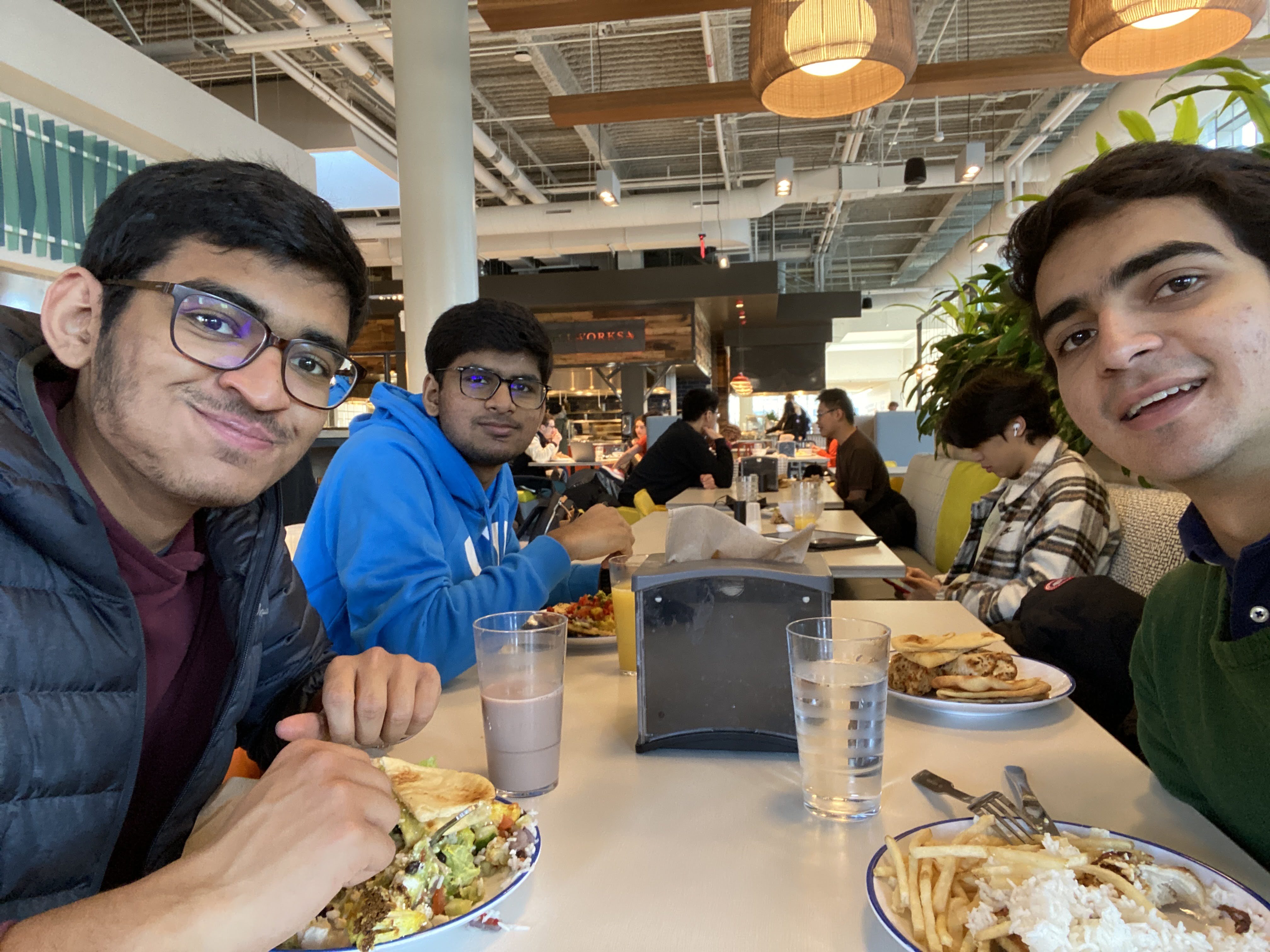
The three of us—Arya, Aaryaman, and I—eating a wonderful meal in the ISR dining hall.
4. After College
You graduated. Congrats. Now what?
If you want to stay in the country, you have some work to do. If not, it was lovely to meet you, let me know what country you will go back to so I can come visit you (like seriously, drop me a note).
But if you do want to stay, here's what you need to think about.
First, it starts with figuring out what you want to do. So, what is it that you want to do?
You want to go to graduate school? Like, actually?
Don't tell me you're going because you want to stay in the country, or because you couldn't find a job.
Or maybe you think the only way to stay in the country is to get a job.
And what if you want something else entirely? Maybe you want to start a company, spend a year traveling, or explore your options.
These questions, and plenty more, are exactly what we'll explore next.
4.1 Job
Job (noun): a way many people trade time, skill, and attention for money, stability, or apprenticeship. Sometimes deadening. Sometimes dignified. Sometimes both.
Work (verb): How a person trades their time and energy for money. In the case of international students, it's also their way of staying legally in the United States, clocking in hours to keep their visa status.
This is the common path.
Some people see it as the safest option. Others feel it’s what they’re supposed to do. And some don’t have a clear plan yet, so earning money feels like the default choice.
Oh, and let’s not forget this. If you’re an international student, no job usually means no staying in the U.S.
After Graduation
After you graduate, you typically get 12 months of OPT (Optional Practical Training). OPT is employment authorization connected to your F‑1 status. It lets you work in a field directly related to your major before you need a longer-term work-visa strategy.
- You must work in a field related to your major.
- Employment must be at least 20 hours per week.
- You can accumulate no more than 90 days of unemployment in total.
If your degree is on the qualifying STEM list, you may be able to apply for a 24‑month STEM OPT extension while you are still in valid post-completion OPT. Your employer must meet STEM OPT requirements, including E‑Verify participation and a training plan.
For STEM OPT:
- Your employer must be registered with E-Verify.
- You must submit an approved training plan (Form I-983).
- The total unemployment limit increases to 150 days across OPT and STEM OPT.
OPT is pretty great because it gives you time to gain experience and figure out next steps before needing employer sponsorship.
After OPT: Work Visas (usually H-1B)
When OPT ends, you need a longer-term status. For most people, that means the H-1B.
The H-1B is a work visa for specialty occupations, and your employer must sponsor the application. It’s subject to an annual lottery, which means selection is not guaranteed. If approved, the visa can last up to six years, typically issued in three-year increments.
There are other work visa options, depending on your situation:
- L-1 Visa: If you're transferring within a multinational company.
- O-1 Visa: If you're "extraordinary."
- And plenty more (do your research)
Green Card (Permanent Residency)
Some employers may eventually sponsor permanent residency, but timing varies wildly by employer, role, country of birth, visa status, and company policy. Start asking early, because green-card strategy is not something you want to discover at the last minute.
This process can take years—especially for applicants from countries like India or China due to per-country limits—so timing matters. Starting early gives you more flexibility later.
How to Find a Job
Finding a job isn't just about clicking "apply." Ask yourself a few basic questions:
- What job do I actually want?
- What am I genuinely good at?
- Which companies align with my goals?
- Who do I already know who could help?
- Where should I live based on my industry and lifestyle?
Many good jobs never show up on public job boards. Usually, they come from talking to people, so talk to people!
Should You Even Stay in the U.S.?
Seriously, think about whether staying here makes sense. Everyone thinks they want that Silicon Valley or big-city job, but that’s not always best. I know lots of people who left the U.S. after graduation because their industry had better opportunities in Europe, Asia, or wherever back home was for them—or they wanted to be closer to family.
Staying in the U.S. can be great if it aligns with your priorities. But leaving doesn’t mean you failed. In some cases, it’s actually smarter.
4.2 Graduate School (Master’s/PhD)
If you’re choosing this path, please, for the love of yourself, and if you don’t love yourself, for the love of whatever it is you love, go to grad school if you actually want to study whatever it is you think you want to study in more detail. DO NOT go to graduate school because:
- You couldn’t find a job
- You don’t know what to do
- You think you will make more money if you have an extra degree
- You want to get promoted
- You want to stay in the country (well, sometimes, you gotta do what you gotta do, but there are other options...)
Got it? Please don’t do it if this isn’t something you intrinsically want to do.
Now, for those of you who genuinely want grad school, awesome! Here’s what you need to know:
Your Advisor Is Everything.
What matters the most in graduate school is your graduate advisor. Again, number #1 decision. The only thing that (probably) matters.
Sure, prestige, location, or food are nice—but nothing impacts your quality of life as much as your advisor. Because all else equal: shitty advisor = shitty life.
So, how can you find a good one?
- First, make sure you really like the research topic and have a genuine interest.
- Next, talk to potential advisors/professors/PIs at the schools you're considering. Or even better, find individuals whose work you admire, regardless of school.
- But that's not enough! Some bad advisors are excellent performers in public, which is why you must talk to their current students.
- Still not enough, talk to former students, especially ones who switched out or left. Ask tough questions. Again, this is the most important decision you'll make.
What else should you consider besides the advisor?
Funding Matters Too. A Lot.
How much funding does the lab have?
A research group with money is way more fun than one with none. You’ll make more progress, stress less, and probably eat better (free food is also very important!).
Know What Grad School Is Really About: becoming a professor.
Think very hard about this commitment. Then think some more.
Don’t believe me? Try becoming a professor without a Ph.D.
Someone asked Freeman Dyson, one of the leading physicists of the 20th century, what he thought about PhD programs:
Interviewer: You became a professor at Cornell without ever having received a Ph.D. You seem almost proud of that fact.
Freeman Dyson: Oh, yes. I’m very proud of not having a Ph.D. I think the Ph.D. system is an abomination.
It was invented as a system for educating German professors in the 19th century, and it works well under those conditions. It’s good for a very small number of people who are going to spend their lives being professors.
But it has become now a kind of union card that you have to have in order to have a job, whether it’s being a professor or other things, and it’s quite inappropriate for that. It forces people to waste years and years of their lives sort of pretending to do research for which they’re not at all well-suited.
In the end, they have this piece of paper which says they’re qualified, but it really doesn’t mean anything. The Ph.D. takes far too long and discourages women from becoming scientists, which I consider a great tragedy. So I have opposed it all my life without any success at all.
—Thomas Lin, At 90, Freeman Dyson Ponders His Next Challenge
But Grad School Can Actually Be Super Fun
If you really want this, grad school can be great. You’ll focus deeply on a specific topic you like, classes get smaller (or disappear entirely after a while in your PhD), and there’s a ton of independent work.
Just make sure you’re doing it for the right reasons!
Pro Tip: When applying to grad school, you don’t have to rely only on the formal application process. You can email the professor you want to work with, or even fly into their city to grab coffee with them. If you both vibe, you’ll be fast-tracked or even informally accepted before your application is officially reviewed.
4.3 Entrepreneurship and Other “Unconventional Paths
You’re an international student. You graduated. You don’t want a job. And you definitely don’t want to go to graduate school.
Does that mean leaving the country is your only option?
Not so fast.
This is not legal advice. Nothing here really is. Always do your own research. But here’s how to think about it.
The U.S. immigration system is not very forgiving to those who want to create their own path right out of college. It’s mostly built around either being a student or being an employee.
However, with some creativity and persistence, it’s doable to be an entrepreneur or self-employed.
Here’s how you can do it:
1. Use your OPT wisely.
- Initial OPT may allow qualifying self-employment. STEM OPT has stricter employer/training-plan requirements.
- Be honest and precise. OPT work must be genuinely related to your field of study. If the connection is not obvious, document the real relationship and ask your DSO before you rely on it. Do not invent a connection because you want the immigration answer to be yes.
- OPT gives you time (up to 3 years if STEM) to launch your startup and build momentum.
2. After OPT, what’s next?
There’s no straightforward “startup visa” in the U.S., but here are your options:
- H-1B via your own company: Your startup can sponsor you, but USCIS scrutinizes this heavily. You’ll need:
- An employer-employee relationship (someone who can fire you, like co-founders or a board).
- You need a real employer-employee relationship and governance structure showing someone can supervise or terminate you.
- O-1 Visa (Extraordinary Ability): If you do something innovative and get traction quickly, O-1 is an option.
- You'll need accomplishments: awards, funding, press, pitch competitions, etc.
- Example: I have a Russian friend who graduated, did OPT with his startup, got into a top accelerator, raised funds, got media attention, and successfully got an O-1 as a founder. Not very easy, but doable.
- EB-2 National Interest Waiver (NIW) or EB-1A: You can self-petition for a green card if your work has a substantial national impact. Usually tough right out of undergrad, but good to know it’s there. This super cool guy made all his application documents available so people can learn.
- International Entrepreneur Parole (IEP): Not exactly a visa, but it gives up to 30 months of lawful status if your startup hits certain funding or revenue thresholds.
- Move abroad temporarily: Canada, U.K., and others have more startup-friendly immigration rules. Some founders go to Canada, get permanent residency, and run their startup selling into the U.S. market until they’re ready to move back.
3. The “Bootstrap & Multitask” Route
Many founders keep a day job (maintaining OPT or H-1B status) and build their startup on evenings/weekends until the business can sponsor them.
4. Get Expert Advice
Talk to an immigration lawyer experienced in startups or what you’re doing. They’ll help you structure your company (LLC vs. C-Corp, ownership percentages) to make your immigration journey smoother.
Your Dreams
Don’t let fear or hearsay be the reason you abandon your dreams. But respect the law enough to learn it. Visa constraints are real; so are lawful options you may not know about yet.
Be like Arya: read the terms and conditions, read the policies, and read the fine print.
If someone tells you “you can’t,” go find out if that’s actually true or just conventional thinking. When there’s a will, there’s always a way.
There is often another path, but you have to find the lawful one.
International Bon Voyage
As always, you might think you have it harder than most people, and honestly, you might be right. It can be tougher to find employers, jobs, and figure out all these visa rules.
And when in doubt, remember: a raw potato never hurts anyone.
But seriously, your disadvantages are often your greatest advantages.
For starters, the fact that you come from somewhere else means your mind is broader, more interesting, and you bring a perspective others just don't have.
You’ll have a ton of fun, it'll be amazing. Enjoy, and don't think too much.

The appendix keeps the examples, guides, profiles, and source trails close. The book gives them sequence, context, and a way to turn curiosity into action.